Showing posts sorted by relevance for query trees. Sort by date Show all posts

Friday, October 1, 2021

CURIOSITIES


With Autumn here, trees get a lot of attention. People plant trees as memorials to loved ones. On a larger scale, the organization One Tree Planted has planted over a million trees around the world. They have provided meaningful employment as well as worked towards their goal of affecting climate change. The significance of trees has caught the imagination of writers with books such as The Overstory, The Long, Long Life of Trees, and Finding the Mother Tree.


Trees are also the focus of the Treewhispers project created by Pamela Paulsrud, an artist and calligrapher, who works with groups to make paper rounds from shredded recycled paper. The wet pulp is spread inside small hoops. Once the paper is dry, each person writes a short story about their relationship with trees. The group attaches the circles to long cords. Pamela has created exhibits around the world using the thousands of circles she has collected. Her latest project included the Kalligrafos Calligraphy Guild. After making circles, the group suspended the rounds on long cords in the winter forest of the Thomas & Brenda Burns' property. People could then walk through the forest of trees and paper circles.


My vista is smaller. I've been picking leaves off the ground as I walk the neighborhood. I've discovered that we have 5 different kinds of oak trees on our street. I've collected red and black oak leaves, both deciduous oaks, and evergreen live oak, valley oak, and possibly netleaf leaves. The leaves of the deciduous and evergreen oaks are quite different, and I questioned why all these trees are classified as oak trees. Lucky for me, Google exists. I discovered numerous societies and studies dedicated to oaks. As I read through the information, I realized, once again, that real research on any subject takes time. A casual researcher like me can find possible answers from experts, but there is always lots more to learn and to verify by collecting data, comparing samples, and asking more questions.

Thinking back to my old science lessons, I assumed that trees could be identified by their leaves and bark. I had forgotten about cross-pollination and how important that is in the life of trees. Looking at the many oak trees in our neighborhood, especially along a creek, I laughed at the idea of these trees busily hybridizing themselves.


My next question: why are the leaves of the deciduous and evergreen trees so different? After reading many fact-filled articles, I concluded that deciduous trees use their leaves as protection from the wind, which is why their leaves are thinner and deeply lobed (valley oaks).  Evergreen oaks need protection from temperature changes so their leaves are smaller and thicker (live oak).

Big or small, our relationship with trees spans centuries. We climb them, we are sustained by their acorns and fruits, we build with their wood and use the wood for heating, we play with wooden toys, we plant them to provide windscreens to protect our crops, and we use the galls and nuts to make ink. 

Best of all, the last question is: 
What better way to spend a hot afternoon than under the shadow of a sheltering tree?


Good sources to understand tree identification:

https://calscape.org/loc-California/Quercus(all)/vw-list/np-0? 

https://www.hellis.biz/why-do-different-trees-have-different-shaped-leaves/

https://www.internationaloaksociety.org/content/hybridization-quercus-seen-through-eyes-enthusiast

https://lizzieharper.co.uk/2013/10/botanical-illustration-compound-and-simple-leaves/

Check out Pamela Paulsrud's Treewhispers' blog:

https://treewhispers.com

Vimeos of Treewhispers exhibits:

https://vimeo.com/340542783

https://vimeo.com/612638534

Check out the Kalligrafos Calligraphy Guild:

https://kaligrafos.com

YouTube video about OneTreePlanted:

https://www.youtube.com/watch?v=tC7QsnezCLc

Friday, December 28, 2018

GOLDEN SEASON

Do you know the tree that is sometimes called Duck Foot?  
This week's post by Sharol Nelson-Embry tells the story of the ginkgo tree, 
an ancient tree first found in Asia.


photo by Sharol Nelson-Embry
               

"I love this time of year with festive yard decorations around town and ginkgo trees putting on their bright-golden, leafy finery. Walking the quiet streets of my island-city town in San Francisco Bay, to exercise the dog and stretch my legs, I admire the leathery triangular leaves waving from branches like little banners or the drifts of them on the sidewalks and streets. When my children were young, we took every opportunity to explore and play in their bounty, throwing armfuls of them up in the air to rain down over us. My children are grown and flown now, but the trees remind me of the fun of those winter days.

Ginkgo trees are amazing for more than their colorful leaves. They exist largely unchanged since the Jurassic period, when they were widespread and dinosaurs roamed the earth. The trees are termed "living fossils" and are part of the conifer family. They nearly went extinct. Their salvation can be credited to Buddhist monks who found a few surviving trees and began cultivating and spreading them throughout China, Korea and Japan. Some of the oldest specimen are found adjacent to ancient Buddhist temple sites.


photo by Sharol Nelson-Embry
             

Their edible nuts are considered a seasonal delicacy, though you have to put up with the noxious smell of the pulpy fruit that surrounds the ripe nut. The nuts are probably the main thing the monks were trying to perpetuate. Ginkgo trees are diecious, with separate male and female trees. Our street trees are primarily males as folks are averse to the stinky mess of the fruit borne by female trees, though I've come across a few females that somehow managing to avoid the saw.

The trees are very hardy, resistant to insects, disease, and poor air quality, part of their secret to longevity and popularity as city trees throughout the world. In Japan there are some trees that even survived the nucleur bomb in Hiroshima. It was predicted that nothing would be able to live in the bomb site for at least 75 years. The sturdy trees, though, survived and are still standing in what is now "Peace Park."


photo by Sharol Nelson-Embry
             

The Ginkgo is actually a mispronunciation of the Chinese word "ginyo," which means "silver apricot." German physician and botanist, Englebert Kaempfer, traveled in Japan in the 1690s and brought ginkgos to Europe. Other names for the tree include "duck foot" and maidenhair tree. Duck foot is clearly related to the shape of the leaves. Maidenhairs seems to refer to a Japanese superstition that if a young girl brushes her hair under a full moon beneath the branches of a ginkgo and thinks of her love, they will marry.

When a tree species has been around for such a long time, it's bound to gather many stories, names and superstitions. As recently as the 1970s people believed that substances in the leaves help improve memory and prevent memory loss, probably since the leaf shape resembles a cross-section of the brain. No scientific research has proven the efficacy of this belief.

John Muir said, "Everybody needs beauty as well as bread, places to play in and pray in, where nature may heal and give strength to body and soul." Nature instructs, heals, and inspires me. I hope you find your own connection with our beautiful natural world through the doorway of my blog:
https://bayislandnature.blogspot.com/

Large Ginkgo leaf from Tokyo's Arisagawa Park      photo by Martha Slavin
Sharol Nelson-Embry is a retired naturalist in the East Bay who continues to write, explore, and also loves chocolate!


If you'd like to read more about this beautiful tree species, you can find more information here:

"Autumn Crown of Gold: Three Ancient Japanese Ginkgo Trees" by Takahashi Hiroshi
https://www.nippon.com/en/views/b05306/

"The Symbolic Meaning of the Ginkgo Tree" by Karyn Maier
https://www.hunker.com/13428589/the-symbolic-meaning-of-the-ginkgo-tree

"Life Story of the Oldest Tree on Earth" by Peter Crane
https://e360.yale.edu/features/peter_crane_history_of_ginkgo_earths_oldest_tree

Friday, October 27, 2017

TREE BATHING


Secret Life of Trees, chapbook by Martha Slavin


Though I love trees, I was somewhat skeptical when at a writers' retreat recently in Marin County, we were invited to go forest bathing. I'd first heard of the expression last summer from one of our nieces who lives in a large city and wanted to go tree bathing to reconnect with the natural world. Forest bathing or Shinrin-yoku became a Japanese practice in the 1980s when Japan included the practice in a public health program. The Japanese have studied the effects of a walk in the woods and the restorative value of being out in nature. We all know how soothing being in nature can be, but somehow in our busy, concrete-laden world, we sometimes forget to walk on the grass and take a deep breath.

I'm intrigued by the idea that trees talk to each other. I am not someone who has sought spiritual or mystical relationships with trees, but I am thrilled by the science behind how trees communicate with each other.  Research by Suzanne Simard at Yale shows that trees interact with the fungi in the ground and network with other trees in the neighborhood by exchanging nutrients and information about the family of trees around them. There are even trees called Mother trees, the oldest tree of a species who has the knowledge of the community of trees within its area.


I didn't expect much as we group of writers stood together at the top of a hill ready to experience forest bathing and write about it. We stepped on the well-worn path leading into a small wooded area. I find it hard to be mindful when I am not alone and conscious of others around me; but eventually, I settled down and noticed the forest. I saw a tunnel formed by the trees' branches bent low over the path to create a shelter. My eyes caught minute strands of spider webs connecting one tree to another. I only saw them because a slight breeze brought them to my attention as they floated in the air. I followed the fine lines from one tree to the next. Tiny spiders scurried along the lines to wrap up even smaller insects trapped in the webs. Birds, disturbed by our presence, chirped and flew from one perch to another. They wrestle pine nuts from the cones attached to the branches and trunks of Bishop pines along the trail. Flies or native bees swirled around me as I walked near them. Agitated, they darted from one tree to the next and buzzed around my head.


When I returned to the path's beginning, the ground spongy beneath my shoes, I spotted a circle of young pines and sat inside the circle with my back against one pine. I pulled out my journal and wrote the word "connections" while a breeze moved through the tops of the trees. I felt the tree shudder from the top all the way down to the roots of the tree, the vibrations thrumming through my back. I was surprised. I have never felt a tree move this way. I have never been so close to the heart of a tree.


Eco-printing of tree leaves


Read more about the communication between trees:

Suzanne Simard, Yale
https://e360.yale.edu/features/exploring_how_and_why_trees_talk_to_each_other

Read more about Tree Bathing:

http://www.shinrin-yoku.org/shinrin-yoku.html

Tree Bathing  QUARTZ
https://qz.com/804022/health-benefits-japanese-forest-bathing/

Thursday, September 12, 2019

TREES TO PAPER


by Joan Stevenson


We humans tend to think that we rule the world. After all, we have tamed horses, dogs, cattle, oxen and other animals to do our work. We cut down trees to provide shelter and for energy, we clear the land to grow crops and turn trees into paper. We think of ourselves with great power until we are confronted by hurricanes, far-reaching fires, and other deadly storms. Then we remember how really small we are.


by Martha Slavin

I was reminded of this concept while reading Richard Palmer's The Overstory. Palmer presents the idea that trees are the owners of earth, not the human beings who only travel beneath them. The tale relates how trees are interconnected in a vast network through their roots and branches, how they provide shelter, and turn CO2 into oxygen, and how we abuse them all over the planet.

The book is a good but sobering read. As a voracious reader, I love the feel of books in my hands and pass them on to others to read. As I rub the paper, I'm reminded of the trees that made that book.

We all have stories about trees in our lives. I remember planting the 5-foot sticks that now tower over our house. I remember climbing the maples and alder trees in my childhood backyard. I remember watching as my kite tangled itself in the branches of the one tree on a beach I was walking on.


by Martha Slavin

Pamela Paulsrud, an artist and calligrapher, asks people to tell their tree stories for her Tree Project. She organizes workshops for all ages. Attendees take recycled paper scraps, soak them, mash the slurry in a blender, spread the wet pulp into a circle frame across a fine screen, press the water out and make new paper from the old. Once the circles are dry, each person writes their tree story on the circle. Paulsrud then collects the circles and hangs them on lengthy strings, like a forest, suspended from an art gallery ceiling. Walking through the circles quiets everyone, almost as good as going tree bathing. A couple friends and I completed our circles and they will be included in her ongoing project.


Circle Forest created by Pamela Paulsrud


Other artists recycle books by making them into paper sculptures or repurposed artist books. A book can become a precious memento of a special occasion as Micki Cooper did for a nephew's wedding. Not only did she recover the cover with handmade papers and photos, but she turned the pages in a pattern to create a message for the bride and groom.


Repurposed book by Micki Cooper


You can learn this process by checking the instructables website listed here:


https://www.instructables.com/id/Folded-Book-Art-Best-most-clear-Tutorial-available/

To purchase patterns for folded book art:
https://www.foldedbookartpatterns.com/shop/

For information about Pamela Paulsrud, check out her blog for some beautiful examples of the circles:
https://treewhispers.com/blog/

Best of all, this weekend, plant a tree.

Thursday, April 2, 2015

WHAT BRINGS SPRING TO YOU?

What are your first signs of Spring where you live?


We can tell it is Spring when the pollinators make our Japanese maples and liquidambar trees thrum. Above our heads, the bees dance and knock the flower stems out of the trees. The sap drops on the deck. Our shoes pick up the stickiness and we make snapping noises as we walk.

The bees in our trees are not all honeybees. Some are smaller with straighter, hairless bodies. I've tried to identify them, but they are too high in the trees to photograph so they remain a mystery. Bees, flies, wasps -- any of these could be pollinating our trees. While trying to identify our pollinators, I've discovered that there are about 25,000 species of bees worldwide and they are endangered.  I am just grateful when I hear them in our trees every Spring. They, like Spring green, are a sign of renewal and hope.


We have friends who are beekeepers. We have ventured close to the hives to watch in fascination as the bees squirm, shake and fly to flowers in the hills near Mt. Diablo. I have never seen a wild nest of a California native bee. Some live underground like bumblebees and miner bees, and others build hives in trees. I am still looking.


When I visited Shakespeare's home in Stratford-on-Avon, the bumblebees hovered over the alliums in the garden.


Spring also brings the Tiger Swallowtails back in the garden when the weather warms. Every year we have one or two that flit around the yard starting in early Spring and continuing through the Summer. They never seem to touch down, but float across the trees and flowers. They live about two weeks so we see the cycling of many generations during the warm months.

Bees and swallowtails are delights and remind me to take time to sit awhile and enjoy what nature brings before me.

In the process of trying to identify our yearly visitors to the garden, I've come across some helpful websites:

Two honey vendors who can be found in local farmers' markets:

http://therabeehoney.com (located in San Luis Obispo County)
http://stevesbees.org (located in the East Bay, San Francisco Bay area)

three sites with information about bees and butterflies:

http://www.buzzaboutbees.net/types-of-bees.html 
http://www.helpabee.org
http://www.thebutterflysite.com

and don't miss the Spring edition of Edible Marin and Wine Country, which has several articles about bees. http://ediblemarinandwinecountry.com


Other signs of Spring:  we start cleaning -- decks, garage, offices. What do you do when Spring comes?


Friday, May 9, 2025

A PAUSE FOR ALL THINGS ALIVE


Robin's Nest by Martha Slavin

Crows, seagulls, sparrows, pigeons, an occasional hawk, and one robin couple congregate in our neighborhood. The robins chirp at each other with their distinctive cry, perhaps while they are looking for a good nesting site outside our window in the cherry blossom tree, whose leaves have begun to unfurl, the last of the trees in our area to flourish. One morning, a crow swooped down into the courtyard, and the robins took wing and haven't returned.

This morning, we watched as a crow made sweeping circles around the roof and windows of the building across the street. At first, we thought this unusual behavior was the crow having fun, but then the crow descended behind some ducting on the roof, only to appear moments later with two other birds to fly behind another rooftop ledge. A moment of quiet, and then a hawk, a crow's natural enemy, burst out, diving and swinging out of the crows' attack. The hawk rose and flew away with the crows in hot pursuit.

We have Pacific Madrone trees on our block. Around the corner, magnolia trees line the street. The courtyard outside our window is full of Japanese maples, cherry trees, and red maples, which give us color in three seasons and bring birds, including the parrots that have escaped into the wild. We can hear the parrots' raucous chatter but find it hard to see the groups gathered in the dense foliage of the street trees. Occasionally, we enjoy songbird finches trying to find a place in a city that doesn't welcome them.

A ride on the N Judah Muni line from its beginnings at the end of Judah Street in the Sunset District to the Embarcadero gave me a glimpse of the entire city. The Sunset District near the edge of the Pacific Ocean used to be all sand dunes. Builders constructed modest homes in the early twentieth century, and the area continued to be developed until the dunes disappeared. Rolling through the Sunset on the trolley, I saw few streets lined with trees. Without trees, the streets seemed bleak and uninviting in the looming fog. At the end of the Sunset, the N Judah descends into a tunnel. As we moved towards the opening, I felt as if I were on an amusement ride going into another world. When we came out, we were in the Noe Valley/DuBose Triangle area, a section of town filled with tall trees, hills, and well-maintained Victorian homes. At the edge of that area, the N Judah descended again into another tunnel that follows the path of the BART subway line across the downtown section of San Francisco to emerge again into the open at the Embarcadero and the Ferry Building with views of the Bay, container ships, and sailboats. The N Judah continues to the CalTrains Depot, but I got off at the Brannan stop, a short distance from our new home.

Today, as we had a picnic lunch near South Park, I watched a yellow and black Swallowtail flit from one tree to another across the street. The butterfly reminded me of a poem I wrote after seeing another Swallowtail cross a busy street:

A swallowtail

At a crosswalk

On a six-lane street

Fluttered across with the light.


****************

On Mother's Day, to honor my mother, long gone now, I am including two of her art pieces:  a flower drawing in pencil and an oil painting in the Impressionist style, of a girl fixing her hair. I was the model for this painting. It took long hours of my sitting still, holding my hair above my face, but gave the two of us time to be together.


by Esther B. Heimdahl

Flowers by Esther B. Heimdahl


****************


 "I am thinking of artists such as Frida Khalo, Corita Kent or Louise Bourgeois, and many others. I hope with all my heart that contemporary art can open our eyes, helping us to value adequately the contribution of women, as co-protagonists of the human adventure."  Pope Francis  


****************

APRIL 2025 New Window View


Friday, September 5, 2014

DOWN A MUDDY PATH


I am a gardener. People who garden work against nature. We plant plants that need water, we put plants where they don't belong. Even a succulent garden needs water once a week. If I didn't garden, our home would be surrounded by the golden grasses, oak trees and mesquite that are native to our area. (Not a bad idea, really) We have a beautiful garden. Even with the shade the trees provide, this drought year, our garden is suffering in a severe drought.

A leaky faucet set us down a muddy path. Around us dirt flew, stethoscopes probed. We were looking for a leak that was spewing out gallons a day. In water-starved California, we cringed as we realized our efforts at saving water by taking Navy showers, turning down sprinkler settings or not planting water-thirsty annuals, were minuscule efforts compared to the water lost in our garden.We discovered  the culprit and we capped off a forgotten faucet at the top of our hill. Our trees  nearby had broken the pipes leading to the faucet.  (We found the leak by subscribing to EDMUD's WaterSmart, which graphs residential water usage. https://watersmarttoolbox.com)  


We, like so many Californians, have been seduced by the thoughts of cool English gardens -- green places sheltered from the sun. In our garden that we planted long ago, we grow flowers that bloom every season, fruit trees that depend on water to bear fruit, coastal redwoods, and the green grass that every home in our town seems to require. I watch my garden with a sad heart as the leaves crinkle up from the heat and the grasses grown brown. This year we need to make hard choices.


A visit to Ruth Bancroft's garden in Walnut Creek reminded me of the true landscape of this part of California: dry and parched in the summer with plants sustaining themselves with winter rain.  Ruth Bancroft, who celebrated her 106 birthday this past week, planted a garden of succulents and cacti that can survive with a weekly watering.  (Check out the garden at www.ruthbrancroftgarden.org

What I liked best about her garden were the trees that she planted.  Underneath the trees, there was no grass, but there were picnic tables spread with cheery tablecloths. Though the temperature was hot, the shade of the trees made a comfortable place for a picnic. The need for green grass and flowering plants seemed less important when friends could gather around a table for a good meal under the shade of a native California tree.


Friday, February 12, 2016

WIND WALKING

The weather changed today. Our week of early Spring arrived with the wind. Walking towards the wind becomes a challenge as my legs are pushed this way and that so I can't walk in a straight path. Makes me think if I just raise my arms, I could fly.

The weather changed today. I look up hoping to see the Peregrin Falcons that have returned to nest near Mt. Diablo. I am envious instead as turkey vultures glide effortlessly with the wind.

The weather changed today. The last dry leaves scurry across the road, the grasses bend trying to follow, and my hair does too. I hear the grumble of the wind as it builds in the tree tops and knocks off branches at my feet. One old oak tree lost a branch that is trunk-size. It must have come down like thunder.

The weather changed today. The fruit trees are confused. They usually flower in order: white-flowered pear trees, apple, peach and plum trees, then cherry trees, and finally, tulip trees. This year the tulip trees came out first, fooled by an earlier warm spell in January. Now the others are all in bloom at once, trying to catch up.

The weather changed today. The glad rain we had in December and January has blown away. As I walk, I worry: are we back in a drought? We could be, unless our usual stormy March comes swaggering in. We can only hope and continue to walk, this time, downwind, with the wind shoving us back home.


******************************

I love the Grey Days photos you have sent in.  Here is another one from F R:


You can still add Grey Days photos to my Google + account at 


or my Instagram page at #postcardsintheair


or my Facebook page at Martha Heimdahl Slavin

My post, Challenge: Many Shades of Grey has been chosen as a blog post at Story Circle Network, a great online place for women writers.    https://onewomansday.wordpress.com


*****************


If  you would like to know when flowering fruit trees are supposed to bloom, check out this website:

http://www.californiagardens.com/Lists/Deciduous_Fruit_Tree_list.htm

Friday, January 11, 2019

GREEN IS HARD TO COME BY

Yosemite in Winter, painting done at end of last watercolor class

New Year
New start to watercolor class

Each new watercolor painting feels like I have to learn watercolor all over again. I don't have the 'feel' for it that comes from deep practice. Each time I have to relearn to mix colors together, figure out the right consistency of paint-to-water, and most of all, I have to slow down.

I tend to attack painting. I want quick, masterful results, which rarely, with watercolor, happens for me. I need to go back and remember to draw what I see not what I think the images look like before I apply paint, and I need to know what colors mixed together give me the hue that I am looking for.

And I need to slow down.

I love making color swatches. They help me understand what colors mix together to give me the hues I want. My favorite set is this one which shows a variety of cool and warm greys.


Shades of grey
Painting trees has left me frustrated with making greens. In order to find different greens, I need to understand that both yellows and blues can be warm or cool and can make the resulting mix warm or cool depending on the ratio of yellow and blue. I had been mixing Cadmium Yellow Pale (CYP) together with either Cerulean Blue, Ultramarine Blue or Cobalt Blue. The combinations gave me a warm, almost gold, greenish color. But I wanted a cool green as well.


Can you pick out the warm and cool yellows here?

I went back to basics and made color swatches of different yellows mixed with different blues. I finally found the cool green I wanted with Cadmium Yellow Light and Cobalt Blue. Another version came from mixing Lemon Yellow or Hansa Yellow with Cerulean or Cobalt. 


Here I succeeded with both warm & cool greens


Sketchbook of Trees

Trees aren't always green. At sunset these trees where dark blue (indigo) and light grey

Evergreen trees at sunset
While my watercolor class was on hiatus during the holidays, I decided to concentrate on painting trees. What better way to practice greens? I tried some practice pages and tried to avoid my painting nemesis, Mud. To change the shade or tint of my greens, I added different blues, violet, Burnt Siena into my original yellow and blue. Often they turned to Mud.


By painting every day, I was hoping to leap across to intrinsic knowledge of my colors. Did I succeed? When I set up my painting equipment this Wednesday, I felt that same hesitation before I started. How do I paint with watercolors?

Then I remembered to take time. I sketched out the scene, I made some color swatches, and then before I knew it, I attacked the paper.  Another misfire.


So, I turned the paper over, redrew the scene, made more color swatches, took a deep breath, and slowly, inch by inch began the painting.

Unfinished, but better greens


This week I also took a class with John Muir Laws who demonstrated the use of a flat water brush to make tree shapes.


Check out watercolor classes with Leslie Wilson:
http://www.lesliewilson.net

For a comprehensive list of cool and warm colors, seek Birgit O'Connor's website: http://birgitoconnorwatercolor.blogspot.com/2012/04/warm-cool-colors.html

John Muir Laws, a naturalist, author and illustrator, offers classes in the SF Bay Area:
https://johnmuirlaws.com

Friday, December 25, 2020

WE LIVE WITH TREES


 The wind bellowed down our hill the night before last, shaking our house and waking me up. At 3:30 I got up to close the window that had been creaking back and forth in the wind. At four o'clock, I heard a boom outside and knew something big in our yard had come crashing down. We've lost trees to storms in previous years. I thought of the three trunk stumps in the back. Instead of taking the trees down completely, we had someone carve bears in the stumps left behind.


The tree broke the top bear in the stump into two pieces


We planted redwood trees years ago on the hill at the back of our house. Like twigs at first, they now tower 4 or 5 stories above us. Their trunks have expanded so that the circumference of the biggest one is 21 feet around. They appear to be strong, sturdy, and indestructible. Their roots fill the hill so that it is hard to plant anything beneath them. But they are vulnerable. The one closest to the bottom of the hill has been struck by lightning a long time ago. The trunk split into two trunks and continued to grow skyward. Closer to the top, the bigger trunk again was damaged, split, and now has four trunks pushing towards the sky.

The lesser of the two original trunks broke from the tree and crashed down in the wind. We were lucky because it came down parallel to our house. The wound left on the tree runs down the side for four or five feet, glaringly creamy white in the sun. The telephone pole-like remains on the ground reached almost to the other side of the yard forty feet or more, the size of a small tree, heavy enough to smash everything underneath.


The fallen tree pulverized one bear stump, the bears dissolving into crumbled wood, and cut another stump in two. The Pride of Madeira bush that had been thriving and the Carpet roses near the stump disappeared under heavy branches. The pear tree looked like it had a bad pruning job. The wisteria lost its crown. When we walked into the yard, we were stunned. We knew that this tree was weakened, but the task of removing it had always seemed monumental with either someone climbing up the trunks or a crane precariously reaching for the top. So we left it, hoping that the trunks would withstand the wind.


The broken top half of one tree stump


The remaining bottom half


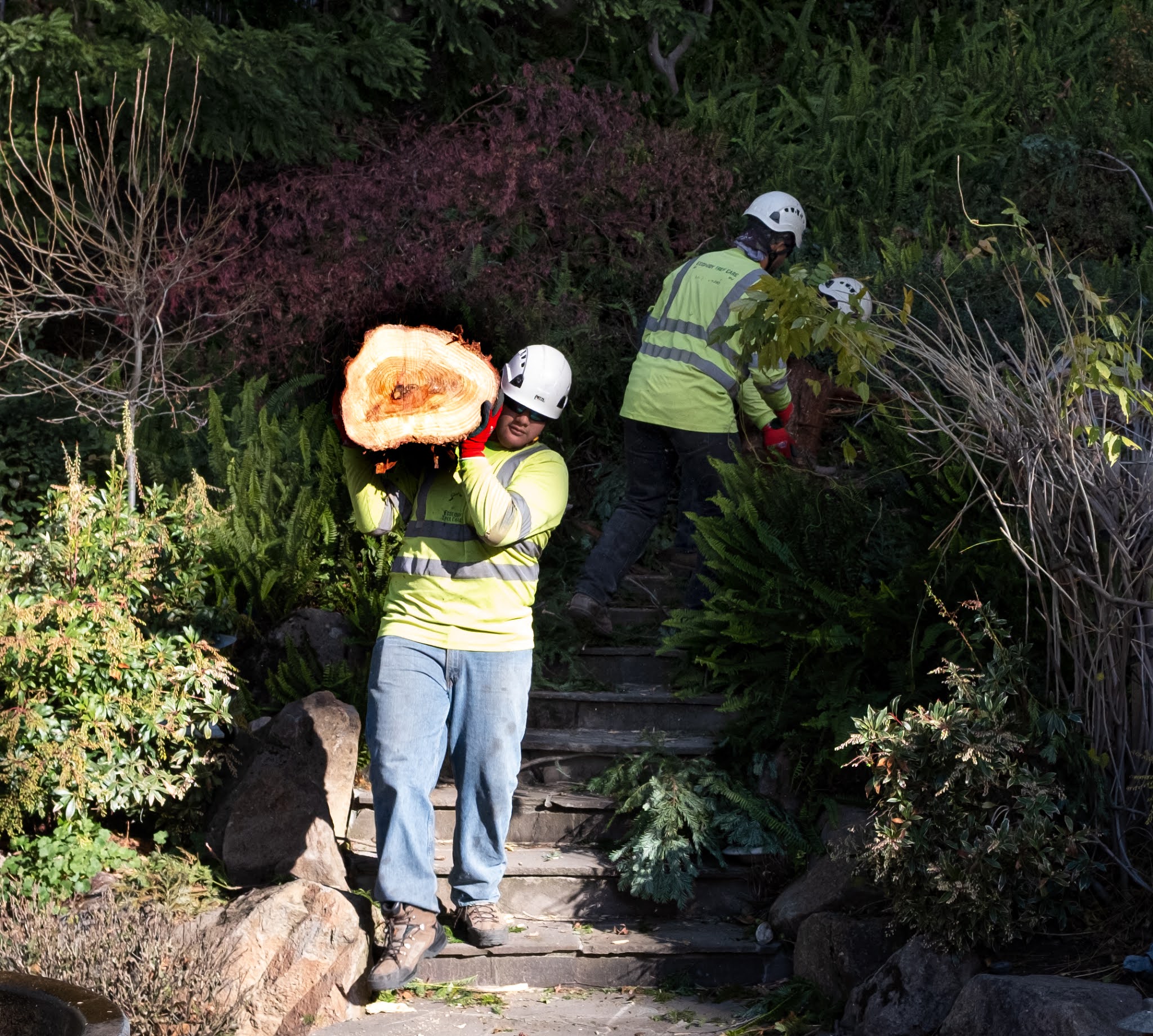
We called a tree service and they cut the fallen tree into sections, carrying out five-foot pieces to their shredding machine. Bill asked them to cut a slice of the trunk to keep. With the clean-up completed, we looked at the tree slice. Bill counted the rings -- 21 in all -- 21 years since the lightning strike which had separated the trunk into more fragile pieces. We both ran our hands over the rough, still moist piece, marveling at the growth between each ring, and touched where off-shoots had started to grow.


We have one unscathed redwood stump with three bears. The tree, which should have died after it was cut to the stump, flourishes and sends sprouts from the base and the crown of the tree, which we continue to prune down close to the stump. The tree, though, resists our efforts to contain it. It has begun to grow over and around the bears. In ten years, the bears will be gone.


There is always a lesson in trees, whether you go tree-bathing or have to cut a tree down. Redwoods, especially, remind me of their strength and their vulnerabilities. They do not have a tap root like other trees; instead, their shallow roots spread far around them comingling with other redwoods, which stabilizes them all in windstorms. Their thick bark and less tannin help them to survive fires, but they have no defense from lightning that can damage the trunks. They are usually the tallest in an urban forest and can be a lightning rod. The damage to the tree and to our yard reminds us that nothing lasts forever, that even the most sturdy can be cut down, but usually something new will grow in its place.