Friday, November 25, 2022

INVITATION TO READ


Writers love words. 

I collect words and keep a Thesaurus by my side as I write. My favorite English major joke, "What's another name for a Thesaurus?" makes me laugh every time I think of it.

I read the dictionary from A to Z growing up, but I've never wondered how the words in a dictionary are selected. Then I read Pip Williams' historical fiction, The Dictionary of Lost Words, which chronicles the creation of the first Oxford English Dictionary and the people who collected the words that fill the dictionary's volumes.


I was intrigued by the story. Not only does Williams describe the lives of the people who curated the words to be defined, but she included significant historical events that had an effect on the choices for the dictionary. During the accumulation of words for the dictionary which began in 1884 and continued through the publication of the complete set of 10 volumes in 1933, monumental events such as World War I, the suffragette movement, and the Great Depression occurred. A group of men determined the main word choices and definitions based on the number of literary references that could be found. The men in charge often neglected women's words and common marketplace vernacular that were not considered substantiated enough to be included in the dictionary. Even a dictionary has a point of view. The main character Esme collects words that drop out of consideration and creates a dictionary of her lost words.


"Wonderful Words Used Rarely," a page from a letterpress book
 about language by Martha Slavin
(words include adumbrate, arcanum, eidetic,
irenic, muliebrity, perseverate, ratiocination)


A good friend invited Bill and me to the Authors Luncheon in San Francisco at the Palace Hotel organized by the National Kidney Foundation, which gave us the opportunity to listen to a diverse group of writers with new books. We also had a chance to help efforts to support people with kidney disease. We learned from one recipient of a kidney transplant that her grandmother had died of kidney disease. Although dialysis was available at the time, the grandmother was excluded from that treatment because she was Black.

We live in a world of layers, good and bad mixed together. Just as in the Dictionary of Lost Words where women's and common folks' languages were ignored, we need to remember the exclusion of people of color or ethnicity from opportunities that we often take for granted because we are White.


We joined other book lovers as we sat in the beautiful ballroom of the Palace Hotel, one of the few major buildings that survived the 1906 earthquake only to be destroyed by the subsequent fire. It was rebuilt in 1909 and then renovated in 1989. But the reminders of that first Gilded Age still abound in the sparkling chandeliers, the ornate ceiling decorations, and the marble columns lining the grand spaces.

We listened to Billy Collins, Michael Connelly, Jennifer Egan, Margaret Sexton Wilkerson, and Siddhartha Mukherjee as they discussed why they wrote their new books. Wilkerson's book, On the Rooftop, uses the 1950s Fillmore District in San Francisco as a backdrop for her story about three sisters as the Fillmore becomes gentrified and the community around them begins to dissolve.


Other good reads for the holidays:

Siddhartha Mukherjee:  The Song of the Cell
Billy Collins: Musical Tables
Michael Connelly: Desert Star
Jennifer Egan: The Candy House


Read about the history of the Palace Hotel here:

https://en.wikipedia.org/wiki/Palace_Hotel,_San_Francisco

To learn more about the National Kidney Foundation:

https://www.kidney.org

Check out the development of the Oxford English Dictionary here:

https://www.britannica.com/biography/James-Murray

Read about the gentrification of the Fillmore District:

https://www.kqed.org/news/11825401/how-urban-renewal-decimated-the-fillmore-district-and-took-jazz-with-it

Friday, November 18, 2022

DIFFERENT POINTS OF VIEW


This past week has been such a relief with the mid-term elections over and the sense of a new beginning away from the rancor and anxiety that has possessed so many people including me over the last seven years. That feeling of relief matches my uplifted feelings as I walk into my workroom. Here is a place where I can survey unfinished pieces and explore new ways to work on them and be happy.

I step over a stack of pieces I've put aside for another day. I picked an accordion folded piece that I've puzzled over repeatedly. I haven't decided whether to leave it alone as a long, 3-dimensional work or attach a cover so that I can fold the pages into a book. I have a separate piece that I am considering as a book cover. I will keep fiddling with ideas.


One of my favorite methods to reassess what I've done is to rotate the paper upside down. This technique is one of the best lessons that I've learned from making art. Looking at something from a different perspective pulls me away from my self-assurance that what I created the first time is perfect. I can open my mind to other possibilities. I can see what I need to do to make value adjustments, spatial rearrangements, changes in color, and more. 

I belong to the Global HeART Postcard Swap group. Three blank postcards wait on my table today. Each season we are given a theme to work on. I've cut up some watercolors that didn't work and now I've rearranged them on the blank postcards. I took a photo of the three once I glued the watercolor strips down. Then I turned them upside down and realized that a couple of them look better that way. Somewhere on the postcards, I will letter this season's theme, "Thankful."


Which way looks better?  Sometimes it helps to turn artwork in a different direction

The theme of thankfulness also makes me think about why I feel thankful this week. First, I am grateful for a life full of rich experiences, for wanderings that have taken me off my chosen path, for beauty I've found in cracks, and for the hands that have reached out to me in support and friendship and for developing the ability to reach back.

To my list, I added a thank you that democracy won this week over selfishness and greed.

**********


Don't miss out on Pacific Art League's annual member exhibition. 
I have a piece displayed among the artwork.


All in the Eye of the Beholder by Martha Slavin


Friday, November 11, 2022

BELOW THE SURFACE


"Come and Play"


 "You should draw cats," my mother told me a long time ago. I remember her words among the many thousand pieces of advice she gave me. I was puzzled why she suggested that I concentrate on cats in my art. My mom often had ulterior motives beyond her casual advice. Looking back through my sketchbooks, I found very few cats. Cats are hard to draw because other than their faces, there is not much there except for the fluffy fur. Perhaps my mom wanted me to do the work to discover a cat's inner structure. Unless I understood what is underneath all that fur, I would not be successful in drawing them. 


Family Cat


Heads of animals sketches including the top view of a cat


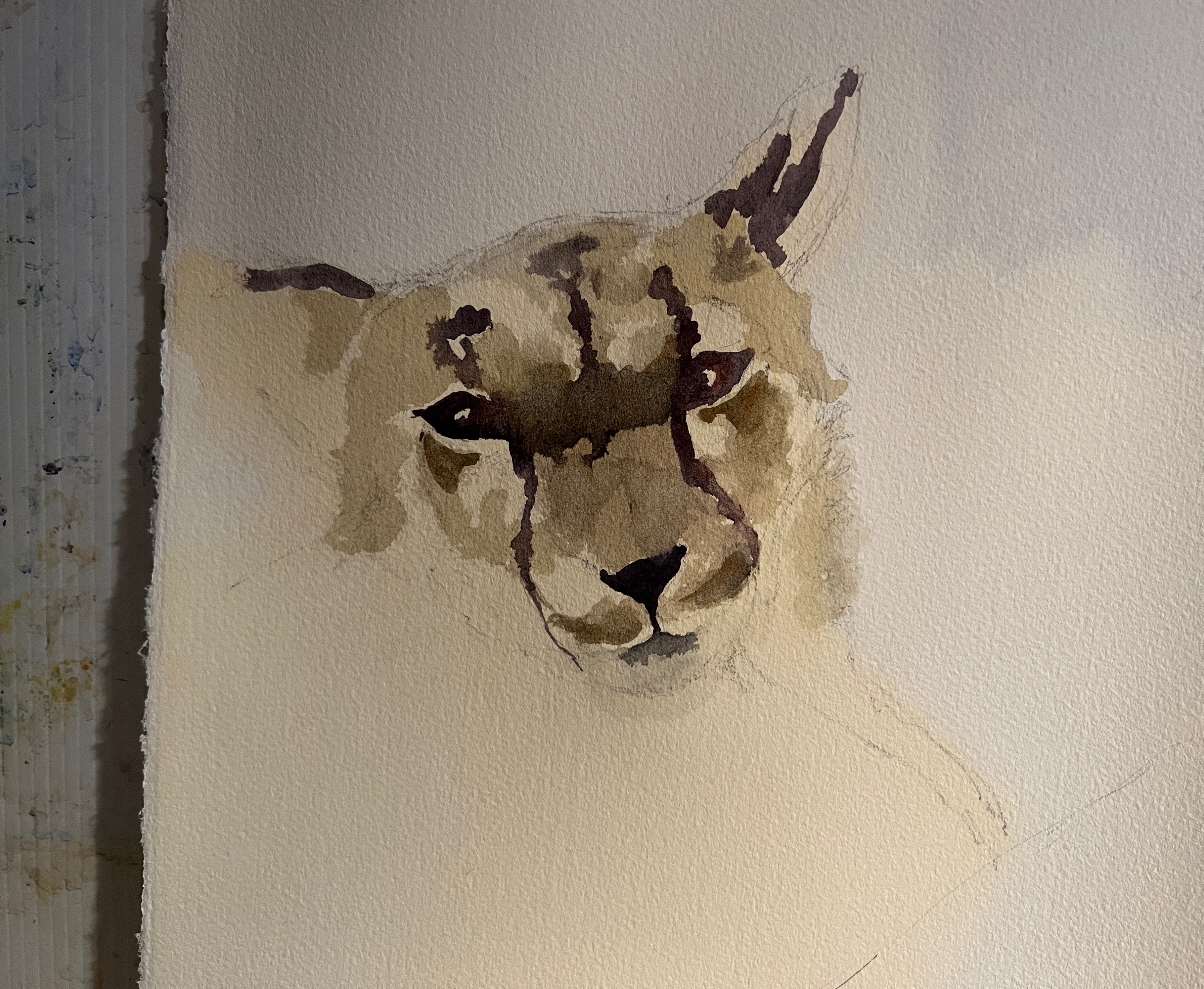
I thought of mom's comment in my watercolor class as we worked on a cheetah, another version of a cat. As a reminder, I am still a student of watercolor. There are many people who paint with much more skill than I do, but this post is about the process of becoming better at something with practice.

To begin, I drew the cheetah on watercolor paper. I'm good at drawing, but sometimes the drawing gets lost once I paint over it with watercolor. Sometimes that's good so that I don't end up painting within the lines, sometimes it's not helpful when I lose the structure of what I'm painting.


I started painting the eyes since they are the focal point of the picture. I like drawing eyes, but painting them isn't always easy. Leaving a light highlight somewhere within the eye keeps the eye from becoming a dark hole.


Taking photos as I am painting helps me to see where I need to go back into the painting and correct values. I applied too dark a value under the cheetah's cheek, which I didn't realize until I looked at the photo. I pulled some of the dark paint out of the painting. I still have a lot of work to do before this portrait is finished. Right now the cheetah's head is floating on the paper. I need to show more of the cheetah's body.


I am glad that I have had this project to work on this week. Art has been a wonderful way for me to let go of stress and escape the daily news of the last several years. 

I am glad that Proposition 28, which provides funding for arts education, is likely to pass here in California. As a former art teacher and a practitioner of the arts, I know how valuable art can be for peace of mind and self-expression. Young people especially find the arts a way to belong.

Yeah to California voters for seeing the need for the arts!

Friday, November 4, 2022

PERCEPTIONS


Trompe d'oeil mural in Santa Cruz   Photo by Bill Slavin


Santa Cruz beckoned us on Halloween weekend. We drove over the Santa Cruz Mountains, through the redwoods to the Pacific Ocean. Walking downtown Santa Cruz, we didn't hear a word about the midterm elections (we've voted already) nor about the economy (the streets were filled with people) nor any other downcast news. What a relief to have a moment of peace.


We didn't avoid Halloween because the downtown streets were full of costumed people stopping by stores for Trick-or-Treat. At the corner of Front Street and Pacific Avenue, we listened to a marimba band as they played next to the town's memorial for fallen soldiers. People gathered around, danced, and swayed to the music, smiles on their faces. We bought coffee at Verve nearby, sat, and people-watched while the music played and lifted everyone's spirits.


Photo by Bill Slavin


Santa Cruz and the beaches that line the coast all the way to Half Moon Bay have been favorite day trips since we moved back to the Bay Area after college. We used to spend time at various beaches including Natural Bridges, Pescadero, Bean Hollow, and Pigeon Point with its lighthouse. We rarely walked through the downtown Santa Cruz area. We got a different perspective of Santa Cruz while we sat and relaxed. Instead of sunbathers, we saw families and college students, unhoused people and shoppers all mingling together on a chilly afternoon.


Photo by Bill Slavin


On Halloween in 2021 when the pandemic had ebbed briefly, we came to Santa Cruz to hear Janis Joplin's original band, Big Brother and the Holding Company, play at the Dream Inn. At the time, we looked for familiar places to stay close to home to avoid COVID. This year we chose the Dream Inn again but this time so we could be around people who also were returning to a more normal life. That night we listened to Lavey Smith and the Red Hot Skillet Lickers perform jazz and old standards from our balcony. Each musician in the band amazed us with their versatility and skill.


Photo by Bill Slavin


Behind the band down on the beach, a solitary man walked into the halo of the band's spotlight. He put down two buckets and picked up a rake. We thought at first he was one of the unhoused people who wander in Santa Cruz and we wondered what he was doing on the beach after dark. He started to rake the sand till he had a large, smooth oval shape. He picked up one of his containers and sprayed liquid out of the nozzle attached to the container. As we watched him work, a musical note appeared on the sand. He continued to rake the sand around the note and then moved to a new patch of sand. By the time the show was over, he had created four different musical notes on the beach -- an ephemeral piece of art on the sand. As we watched him turn sand into art, we looked at each other and winced at our misconception about who the man appeared to be. An artist, an unhoused person? Did it matter who he was? What he did brought a moment of joy to those of us listening to the music.


*************


Artists have often responded to the events of the day with powerful posters. 

Letterforms Archive in San Francisco is showcasing protest posters about Strike, Resist, Love, and Teach. The exhibit can be seen online. Clicking on each of the four words on their website expands the online exhibit:

https://exhibitions.letterformarchive.org/strikethrough/exhibit/introduction 

The in-person exhibit at Letterforms Archives, 2325 Third St., 4thF, will be open through Spring 2023.


Friday, October 28, 2022

HARMONY IN BLACK AND WHITE


Some words, like detritus and unprecedented, become popular terms for a while. In the art world, the word Notan has been bouncing around lately. If you've seen the Yin and Yan symbols, you have seen a Notan design. Notan is an old Japanese term for finding balance in negative and positive spaces. Maybe Notan design is popular right now because we are also looking for that kind of balance in life. 

School kids everywhere learn Notan when they try the simple paper-cutting technique of drawing half of an image on the edge of a piece of paper and cutting it to make pumpkins, trees, leaves, hearts, and other shapes. Some graduate to making more complicated Notan designs that amaze anyone looking at them. 

Calligraphers play with Notan when they cut out symmetrical letters of the alphabet. A H I O T U V W X all work for Notan designs. Quilters use Notan to balance the darks and lights in their quilts.


Movie title design, such as the titles for the Korean drama, Vincenzo, conceived by Wooktist of Undesign Museum, and the title for The Magpie Murders designed by Huge Designs of London for the PBS Masterpiece series, create strong negative and positive spaces that draw the eye in.


Part of the title design for Vincenzo by Wooktist


Painters posterize photographs to find the balance of darks and lights in a subject.


The original paper craft of Notan can be as simple as cutting out a heart or as complicated as cutting out a landscape or abstract design. It's a good way to play with shapes and ideas.

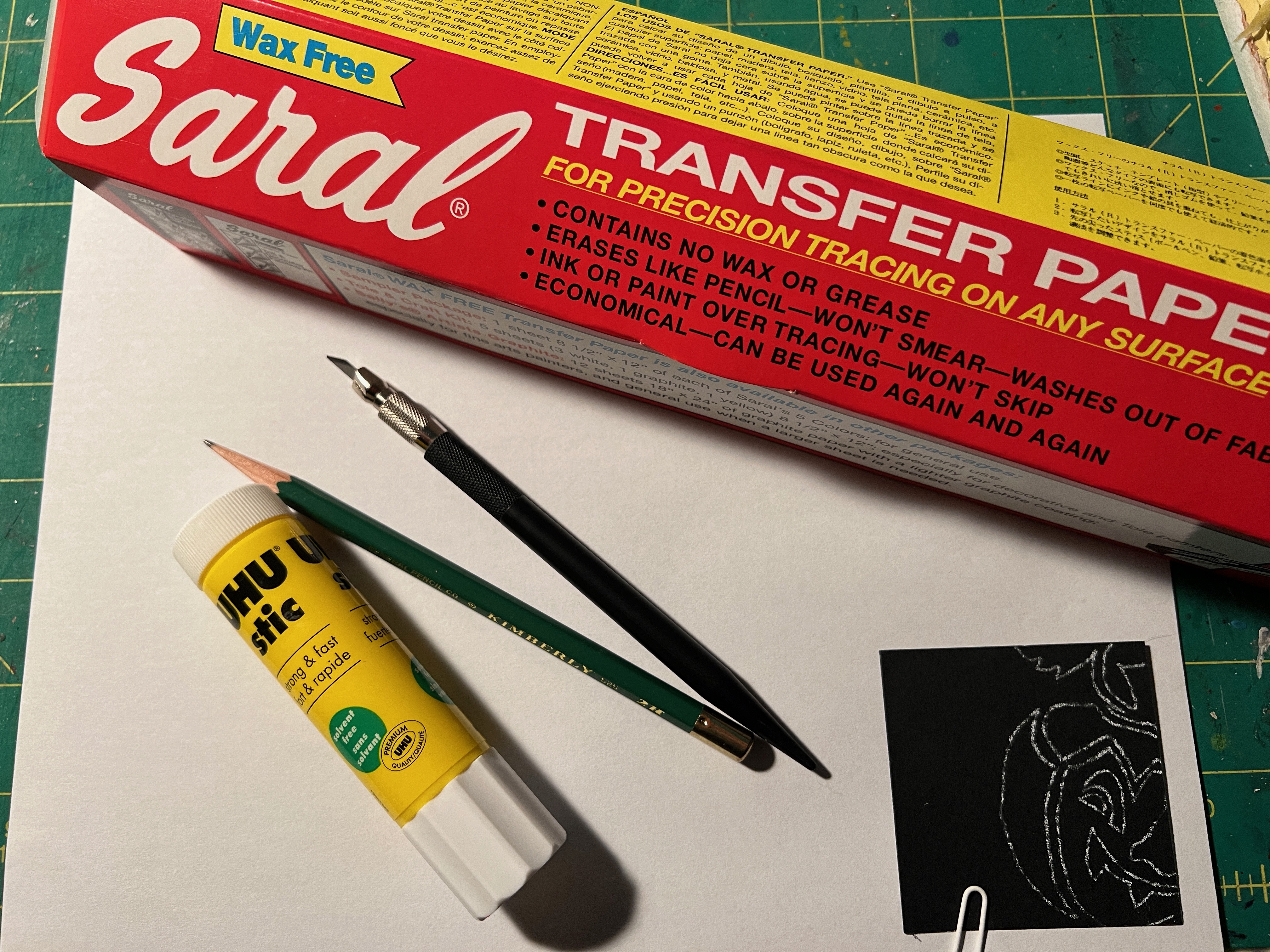
To make a Notan pumpkin you will need:

White or orange paper to glue the pumpkin on.
Black cardstock weight paper (I used Canson Mi-Tientes)
a sharp Xacto knife (#1 blade) or try the Gryo-Cut Crafting knife
Saral transfer paper
glue stick
pencil
kneaded eraser to remove chalk marks


Sketch your idea for a pumpkin.
Cut out a square from the black paper (size will depend on how big you want the pumpkin)
Place a piece of Saral transfer paper over the black square
Place your design on top making sure to align the design to one edge of the black square
trace over your sketch lines


design placed at edge of black square


Cut out the shapes starting with the inner smaller shapes. Place them on the white paper so that the edge matches the edge of the original black paper.

Continue to cut out the pieces and place them so the center edges match. You may want to draw a light vertical line to help get the pieces aligned at the center.


When you have all the sections cut out, glue the pieces down to the white or orange background paper. Let dry and using a kneaded eraser, lightly rub off the chalk marks.
Have fun making Notan!


Check out the work of title designer,Wooktist, here:  https://www.behance.net/Wooktist
Watch the title design segment for Magpie Murders here: https://www.stashmedia.tv/magpie-murders-series-opening-titles-by-huge/

Friday, October 21, 2022

LETTERING IN CIRCLES


What the Sun Said by Martha Slavin

Circles have deep meanings in many cultures. A circle can represent life, eternity, and unity, ideas that seem almost out of reach right now. Those deeper meanings draw me to include circles in my designs.

Trying to get letters around a circle is a mathematical challenge so I took a class recently from Debbie Reelitz, a calligrapher, who showed us the mathematical principles to arrange letters in a circle using measurements of the circumference, radius, and pi to figure out the exact size that the circle needed to be. We used protractors and compasses to measure accurately. 


The tools we used


Two minutes after she explained the process (luckily she gave us detailed written instructions too), I started to follow her lead and found that I had forgotten most of what she said. My long-time math anxiety intervened. My humble hand-lettering abilities raised their heads too. I began to doubt that I could finish putting letters around a circle. Then Reelitz showed us a shortcut that fit my capabilities.

Though I still had to measure, I was able to fit the words I had chosen around a circle. I wrote out the phrase I planned to use, measured the length of the line, cut the phrase out, and folded it in half and then into quarters.


Using a compass, I placed the two compass points at two adjacent quarter marks, which gave me the radius of the circle I needed. I drew the circle and divided it into quarters and filled each quarter with the corresponding letters on the straight strip of paper. (Take Debbie Reelitz's class to learn the complete instructions.)


As a left-hander, I find calligraphic writing to be a challenge. I've practiced a lot, but I don't have the beautiful flow that true calligraphers show in their work. For this project, I decided to use a monoline alphabet, the easiest one for me to draw and one I knew I could have success with. 


All of these examples are my rough drafts waiting to be put on a light table, adjusted for line length and spacing between letters and words, and enhanced with illustrations. Maybe then I will try to use Italic or Copperplate in a circle.


Possible illustration for "and your smile grows wide..." quote


Two other takeaways from Debbie Reelitz's class: I need to remember to turn the page as I draw each letter to keep each letter upright and let the ink dry as I go around a circle or I will smear the letters.


Check out Debbie Reelitz's calligraphy here or take a workshop:

I'm planning to read Math Without Numbers by Milo Beckman in hopes of gaining a new understanding of math. Find the book here:

Friday, October 14, 2022

EYES WIDE OPEN

All in the Eyes of the Beholder by Martha Slavin   (finished piece!)

While we lived in Tokyo, I went to a shrine sale, similar to a flea market, looking for another obi, the long piece of narrow cloth that wrapped around the waist of a woman wearing the traditional kimono, to add another obi to my small collection. I walked by a table loaded with small items and glanced at a pair of round wire glass frames sitting in a tattered case. I picked the glasses up and looked through the glass and felt like I was looking at the world through someone else's eyes. I quickly replaced the glasses on the table and continued my search.

I remembered those glasses as I sat writing this post with my right eye half-closed. I had a corneal transplant surgery recently and am recovering nicely with the help of a patient and strict caregiver, Bill, who won't let me cross over to doing too much activity at once as I am prone to do. 

My sight has changed much since fourth grade when I had to sit about a foot away from the TV to see the programs. I've worn glasses and contacts to correct my nearsightedness and astigmatism, had cataract surgery that gave me one week of perfect vision, developed glaucoma, and now have problems with my cornea.

I don't agree with the idea that every trauma or hard experience makes you stronger. Sometimes it doesn't. In the last week though, I have had a chance to reflect on the deeper meaning of a situation that I can't control. In those moments of reflection, I have found gratitude for good friends, a good, well-lived life, and a husband who cares.


Recently we received an alumni magazine that listed people who attended the last reunion as well as the people who had passed away in the last five years. Looking at the latter list and seeing people who we remembered as vital, insightful human beings, I realized once again how random life can be. They are gone and I am here, grateful to be able to see clearly.


A few years ago, I started a daily gratitude journal. I didn't think it would make much of a difference in my outlook on life, but over time it did. At the end of the year, I went back and re-read what I had written. I noticed how often my gratitude reflected interaction with nature, a good reminder of how much being out in the natural world contributes to my well-being. I seek out writers of the natural world such as Richard Powers, Robert MacFarlane, Margaret Renkl, and Florence Williams, who have all given me a glimpse of the part we play in nature. If we live in big cities or suburbia, we forget sometimes that we are nature and that our actions have connections with the rest. 

My best advice: take a walk among trees.


Some of my favorite books about the natural world