Friday, April 30, 2021

WE CAN ALL USE A BIT OF SUNSHINE


A cup dropped off the counter last week. Anxiety expressing itself?


Glorious weather, blue skies, light breeze, not too hot, and flowers bloom. Yellow tree pollen blankets the road, the walkways, and our car windows. The bees, hundreds of them, buzz at the tops of the trees. They pack themselves with pollen, knock off the tiny blossoms on the Japanese Maple, roar through the leaves of the old walnut tree up the street, and fill the sycamores and oaks with their buzz. 

Alive. Spring.

Remember when the pandemic first hit us? People stood by windows or stepped outside to applaud their first responders. Remember the opera singers on their balconies wrapping their neighborhoods in song. Remember how everyone waved at you when you walked in your neighborhood. Every Sunday we could look up at Mt. Diablo to see the beacon of light lit by volunteers to give people hope. Small signs of the positive side of this experience. During the pandemic, we had an opportunity to examine our lives, our living spaces, our friendships, and the earth we live on. We watched the skies and roads clear. But with all the news from the year, the misinformation thrown at us, and the continuing COVID surges, it is easy to see the dark side. Life is bittersweet, heart-breaking, and more.

A friend reminded us that vaccines have good side effects. The shots have brought relief, brought a desire to be out in the world, and brought us closer to reconnecting with people at last. Spring has brought a buzz that we can all rejoice in.


Sunshine and blue skies give us hope and the promise of better days to come, maybe even without masks. Spring gives us the first glimpse of nesting birds. We watch juncos and finches flit in and out of our birdhouses. Robins hop across the grassy areas on our walk. The first deer stops by the budding rose bushes to take a bite or two or more. She and I stare each other down.

The butterflies are out. We have Swallowtail that visit our yard every year. They float through the yard never stopping to rest. Yesterday I saw what I think was an Echo Azure butterfly, its wings tinged with blue (it could have been a more common Small White, but I like the name Echo Azure -- so much for scientific accuracy). Today a Painted Lady rested on a brown leaf, opening and closing its wings.

Spring. Alive. Hope.

To find hope, we can all listen to what our next generation says. Fellow blogger Chandra Lynn has posted links to her students' blogs this month. Please take the time to scroll through them all, you will feel better from having read what they have to contribute. You can see them all on her blog:

https://iamchandralynn.com   

Because I have family who are on the Autism spectrum, I am highlighting the student blog by Patricia who writes about autism:

https://pbmiranda.wordpress.com/blog/ 


Learning from mistakes, again.

This sketch of Lavendar was complete, nicely done with sharply delineated shapes. I painted the border. Fine. Then I decided to add a background color with too much water on my brush, a problem that I have with watercolor. The darker colors started to leak out around the edges. Oh boy! Oh no! I thought I had messed it up. I would have to cut the sketchbook page up into smaller pieces. But I walked away. When I came back and the watercolor was dry, I realized I liked it better. The edges were softer, making a not-so-great sketch a little more interesting.


And I think my Serenity cup is just the right candidate to try Kintsugi, the Japanese way to repair pottery with lines of gold.

Spring. Alive. Hope.
Friday, April 23, 2021

WHAT WORDS LEAD YOU IN LIFE?


"Sun Dog," photo by Bill Slavin


Do you have a life-affirming idea that you return to when you need to make a difficult decision? Do you rely on the Golden Rule? Or are you propelled by anger? Do you ask the question, "What if everyone did that?" Or do you hope to leave this world a better place? 

The New York Times asked its readers about their personal philosophy of life. The answers have been published each Sunday in April. When I read through the thoughtful and positive responses, I thought of my own guiding principles and wondered if the pandemic had affected my answer. I have always liked the solemn, slow pace of the older version of the Golden Rule, "Do unto others as you would have them do unto you," combined with the idea that "What goes around, comes around." Both ideas give me a foundation to build my life around.

One writer mentioned the Golden Rule but preferred the Platinum Rule as a guide. Instead of assuming that everyone wants to be treated the same, the Platinum Rule asked, "How would that person like to be treated?" In the last year, this rule seems more important as we realize more and more that everyone's life has not been the same and our own desires may not be the norm.

Anger, another answer, surprised me, but the writer suggested that many of her positive actions resulted from her anger at a particular issue. Anger was what got her going. I realized that anger had driven me to participate more fully in political issues this past year than I had ever done before.

Another reader asked of "What if everyone did that?" I thought immediately of the last five years and the constant chaos that rained down on us from the previous administration. We continue to see imitators not only in the public scene, but in our neighborhoods, who have been emboldened to be rude, caustic, and selfish. Those people have made a choice to be self-centered. What if they did the opposite and thought first of other people and decided they wished they had been more kind? They would live up to the code to leave the world a better place.

The pandemic year has shone a light on what we value, what we hold most dear. After reading the letters in the NY Times, I  realized I have added anger to my list of codes this year and changed my viewpoint from the Golden Rule to the Platinum Rule.

Have you made a change in your guiding principle(s) of life?

You can read the responses in the New York Times re personal philosophy:

https://www.nytimes.com/2021/04/10/opinion/letters/personal-philosophy.html?searchResultPosition=20

https://www.nytimes.com/2021/04/17/opinion/letters/personal-philosophy.html?searchResultPosition=11

Wonder what the next generation is thinking? Take a look at these blogs by 4 bloggers, students of Chandra Lyn, a college instructor and fellow blogger:

https://iamchandralynn.com/category/focus-on-black/

Wanea A.: https://unbecoming247.wordpress.com/2021/04/16/no-man-is-a-paradise-island-soul-work/ 

Na'veh:  https://thebloggingsofv.wordpress.com

Tea:  https://steepthetea.wordpress.com

 Jesse:  https://blackmodernthoughts.wordpress.com

Friday, April 16, 2021

OLD SKETCHES COME TO LIFE


by Martha Slavin

 After a weekend calligraphy workshop, getting ready for my watercolor class, and with a pile of stuff remaining from various art projects scattered around my room, I stopped, sat down, and sifted through some old sketchbooks looking for some drawings that I had put someWHERE. I never did find the drawings I was looking for, but what I did find made me happy. I discovered some sketches I never completed hidden in an old tracing paper tablet.


by Martha Slavin *  I have no idea why I drew Toast!


In an earlier time, I had filled sketchbooks with ideas for greeting cards and needlepoint designs. Some of them I finished and sent away to greeting card companies. I had one accepted and published. The rest made me realize I needed to sharpen my skills. I went back to art school at night, but I never fulfilled my ambition to be the next Kate Greenway, Blanche Fisher Wright, or Merry Engelbreit, all-female illustrators. While taking classes, I set aside the greeting card drawings in a portfolio that ended up behind five or six other portfolios filled with various art techniques from printmaking to painting. (Not to mention the dozen boxes on other shelves filled with more recent additions.) Looking through all these portfolios meant looking back through my life, remembering the years when I studied graphic design, illustration, printmaking, mixed media, and drawing.

I decided to complete the old sketches I found. Just for fun. Just not to think about the heavy issues of our days. Just to put some extra color into my life.


By Martha Slavin


I still haven't found the drawings I was looking for. Anyone else have a clue?


Check out the artwork of Kate Greenway:

https://www.pookpress.co.uk/project/kate-greenaway-biography/

Or Blanche Fisher Wright's artwork:

https://www.gettyimages.com/photos/blanche-fisher-wright?

phrase=blanche%20fisher%20wright&sort=mostpopular

Or artwork by Merry Engelbreit:

https://www.maryengelbreit.com/collections/featured-fine-art-prints


Friday, April 9, 2021

WHAT'S IN A LINE?


by Martha Slavin


 A line drawn on paper can tell you so much about who drew that line. Someone with confidence can make that line wiggle with expression with the thick and thin variations of the line. Someone who is hesitant will show that feeling with sketchy uncertainty.

I think of all the people who have told me they can't draw. Then they tell me that a parent, teacher, or friend told them so. I sigh because I think how quickly we lose confidence because of something someone says to us. Those remarks settle into the back of our minds and pop up when we try drawing (or just about anything, for that matter.)

When someone is confident in their skills, you can tell by the way they carry themselves, how they speak, and stand in their own silence. When I played golf, I learned to focus on the ball, almost drilling my eyes into that small round object before I took my swing. I would tell myself, "I can do this." If I lost my focus just for a fraction or if a negative voice spoke up, my hit would go sailing off into the weeds or into a sand trap. I found in learning to play golf I needed to slowly build knowledge of my body, find a positive voice to talk to myself,  and also that one day could be completely different from the next in how good I felt about my game.

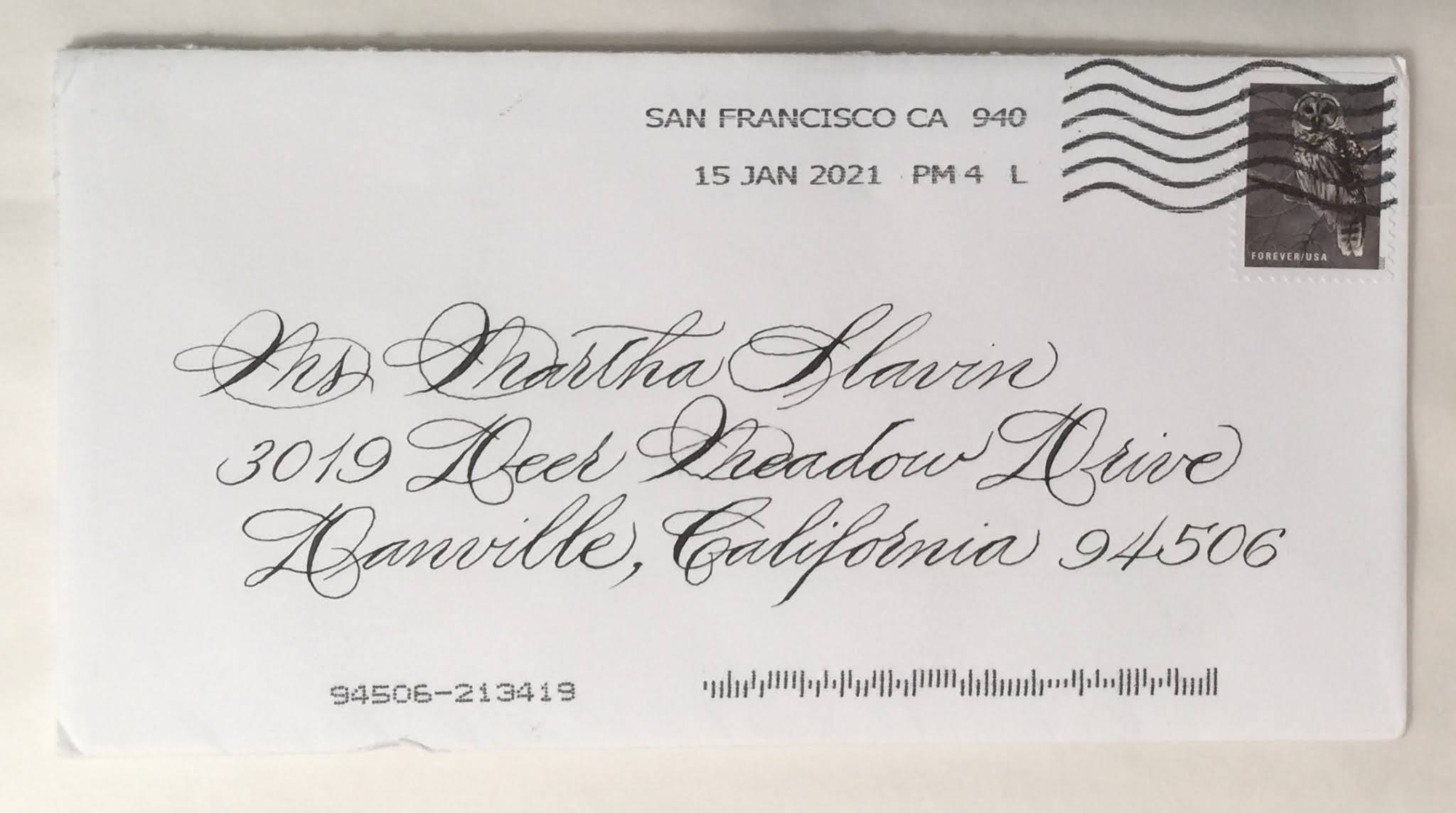
Since I attend calligraphy workshops regularly, I often receive decorated envelopes lettered by the instructors. The quality of their lines exudes confidence. I am sure that each one of them has had days when nothing goes right for them too, but they have decided to persevere. Their work shows how confident they have become.


by Rick Paulus


Next week I will be in a Zoom class with Mike Gold, whose envelope arrived last week. A little piece of art in my mailbox. Inside the envelope was a booklet filled with prompts and examples of abstract calligraphy.


a page from Mike Gold's booklet,
Moved to Abstraction, filled with examples of his work 


Abstract calligraphy? What is that? Most of us think of calligraphy as the practice of precise lettering. A calligrapher studies the various details of the particular alphabet fonts that they have selected. Sheila Waters' excellent reference book, Foundations of Calligraphy, gives you the ability to recognize what each alphabet and each letter needs to draw the letter accurately.

Calligraphers often experiment with letters by writing them on waving lines, writing them without spaces between lines, or writing them around circles. Abstract calligraphy takes those experiments further by using the letters themselves to create abstract work. The words may or may not be legible at that point. You can just enjoy the hand that draws/paints them.


Just as in golf, I found that working with calligraphy or any art technique takes practice, a great amount of focus, and a trust in myself that "I can do this."


Check out Rick Paulus' website: 

http://www.rickpauluscalligraphy.com

Check out Mike Gold's website:

https://www.mikegold-letterarts.com

Learn more about Sheila Waters here:

https://designtraveler.wordpress.com/2011/11/09/sheila-waters-a-link-to-calligraphic-foundations/


Friday, April 2, 2021

A DAY WITHOUT EAGLES


The eagle we didn't see


Have you ever seen an eagle? 
What a testament to rugged beauty and majesty. 
Watching them in videos soaring through the air is magic.

We needed a break from our pandemic life and were looking for somewhere to go that wasn't too crowded during Spring Break. We didn't know that eagles build nests at a reservoir near us. We had never seen an eagle in the wild nor heard of the Los Vaqueros Reservoir, even though it is about 15 miles away as the crow flies or 25 miles by car. 

We primed ourselves for a pandemic adventure away from crowds, while we could enjoy fresh air and a good walk. Not really knowing what to expect, we brought water, walking shoes, sun hats, cameras, and a sketchbook. We were hoping for beautiful, shade-dappled scenery.

To get to the reservoir, a water supply for the Contra Costa Water District, we drove through farmlands and hills dotted with Valley Oaks and small herds of cattle. We timed our visit wrong, arriving at the reservoir around noon, the sun blazing even at this time of year, not the best time for birdwatching. That was okay with us as we wanted to scout out the reservoir first.


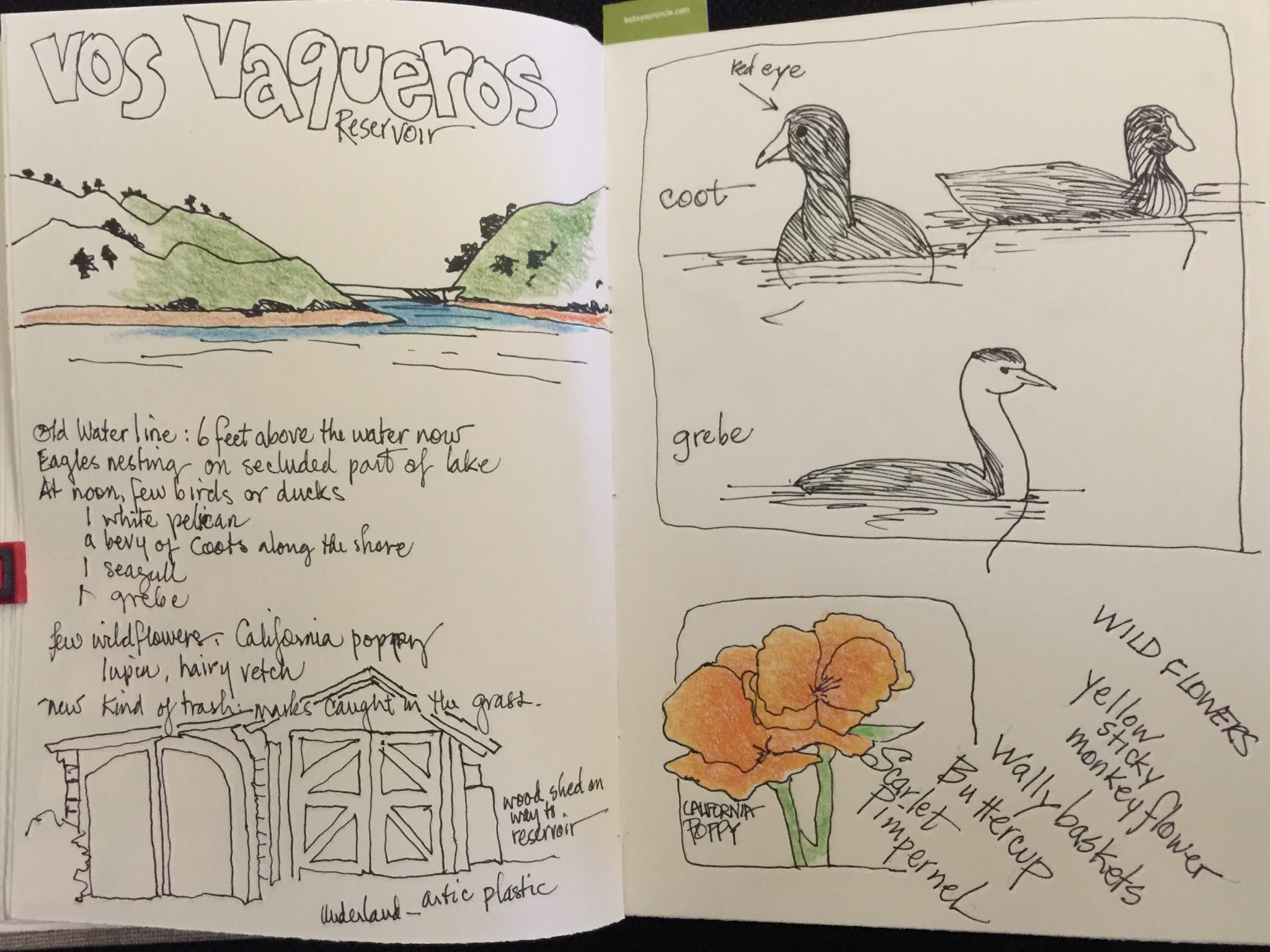
Sketchbook page


We turned through the gate, drove along the low hills with oak groves, to discover a desolate-looking reservoir with hardly any shade. This man-made reservoir looked like others we had visited rather than the beaches and wooded areas of lakes like Lake Tahoe. The water level was about six feet lower than normal for this time of year because of the lack of winter rain. We began to feel disappointed. What we noticed was the emptiness: no birds and a large expanse of stark landscape.  We could see the tops of the dead oak trees that had been submerged when the reservoir was first filled. We parked at the marina and walked to the boat docks. The rental boats were gone, but a few people fished from the docks. Photos of large fish caught from the docks decorated one wall of the marina building.

The trails leading to the eagle nesting area have been closed to allow the eagles privacy. We turned around to the surrounding hills that look like soft suede. The hill grasses had not grown tall like they do after a rainy winter. We decided to try a walk along the shoreline. We picked a gravelly trail that was open and moved north from the marina. Along the trail, a few bunches of California poppies, hairy vetch, and lupin bloomed, but not the fields of wildflowers that may appear in April. Not an eagle in sight.

We walked down towards the shoreline and crossed a low area where the dry bullrush stalks usually would be soaking in water and continued up the trail to a stand of old oaks. We hoped to see a stray eagle or hawk wheeling in the sky above us. We saw a white pelican, a few coots, and a couple of grebes in the water. We kept looking for something to inspire us to take photos or sit and draw.  The path we chose started to disappear so we turned back to the marina. At least, we'd had a good walk.

What was best about the reservoir: the quiet. We couldn't hear the freeway, whose loud hum reverberates around our valley and bounces off the hills. 

Second best: the few people we encountered all wore masks or slipped them on as we approached each other. Even the ones fishing from the docks or shoreline had them on with the exception of one older, husky man leaning on a bench.

Third best after a long, hot walk: the Hagen Daz ice cream for sale at the marina.

Fourth best: the care of the reservoir by the water district by keeping people away from the nesting areas while allowing fishing and hiking. The district works to restore the natural savannah around the water, planting oak saplings in groves on the hills. Some of the trails meander through the new groves. I marveled at the young oaks mixed in with the old since Valley Oaks have been dying off from disease, old age, and development for many years. With our help, they are coming back. At the northern entrance off of Vasco Road, the district built an interpretive center to help visitors understand the flora and fauna of the reservoir.

Though the reservoir looks desolate,  as we looked more closely, we realized the benefits of its spareness. It was quiet, not crowded with people, and a good place to relax from pandemic worries. We will have to wait for the eagles till later.

*******************

Check out these websites about eagles and the Los Vaqueros Reservoir here:

https://www.allaboutbirds.org/guide/Golden_Eagle/id  The AllAboutBirds is a great site for bird identification

https://www.ccwater.com/383/Golden-Eagles 

https://eastbaywild.com/2018/06/18/los-vaqueros-reservoir/


New kind of trash on the trails.  I've seen these at the gutters on walks on our street too.

***********


Good reads here:


Friday, March 26, 2021

TEA AND CHERRY BLOSSOMS


Sheltering in place: what has been a benefit for you? How do you feel about re-entering the world, walking on busy streets, or being in large groups of people? Or have you had to do those things all through the pandemic because your work is essential? 

As an introvert, I've found tranquility and focus during shelter-in-place. But I am puzzled by my anxiety about reopening. I feel the tension between losing my quiet existence at home versus working to regain the social skills that have faltered since shelter-in-place. Once again, as I think about what to write, I have seen the same question I am asking being raised by other writers and other commentators. This time the question is how do we deal with returning and opening up?

Springtime, good weather, and bright skies make it hard to stay home. As I take my walk under the flowering trees that carpet the streets with pink and white, I am reminded of Japan and how the Japanese tea ceremony can quiet the spirit. I remember the Japanese concept of impermanence called mo-no no a-wa-re, exemplified by the fleeting beauty of cherry blossoms. Maybe we can take lessons from far away to adjust our mindset and make our transition easier.

As Sen-no-rikyu, the first tea master, said,

"Tea is but this:

First, you make the water boil,

Then you infuse the tea,

Then you drink it properly,

That is all you need to know."

The Japanese tea ceremony includes some of the elements of ancient Japanese philosophy: harmony, respect, purity, and tranquility. Each word said slowly and by itself is important. A meditation in itself.


The tea ceremony evolved from simple tea at home and is often performed in a separate teahouse centered in a serene garden. The guests are encouraged to use the placement of steppingstones in the garden to meander their way to the teahouse. Visitors remove their shoes, slip on indoor slippers, and then pass through a low door -- all to remind them that they are entering from the outside world to an inner one. The guests are expected to admire the flower arrangement in the room, the calligraphy on scrolls on a low bench or wall, and the kettle where the water is brewed. They kneel on tatami mats that cover the floor and share a bowl of thick macha made from green tea powder whisked with a bamboo chasen. They admire the bowl as they drink, then turn the bowl to present it to another person. A sweet cake is offered to offset the macha flavor. From the first step in the garden to the end, the tea ceremony is a way to slow down and notice the environment around them. When the ceremony is over, the guests rise quietly, bow, and leave through the garden.


While in Japan I belonged to CWAJ, a women's organization that provided scholarships to Japanese and foreign students. When the students gave their oral presentations, they first participated in a simple tea ceremony in the gathering room. The tea ceremony gave them time to calm their anxieties and collect their thoughts before they faced a group of women examiners. Many companies in Japan still set aside tea rooms for the same purpose. 

With the mass shootings this week and the continuing political stalemates in Congress, we could follow the Japanese example and learn to quiet our thoughts before we act. 

Anyone for a cup of tea?


If you would like to learn more about the Japanese tea ceremony:

http://japanese-tea-ceremony.net

Cherry blossom viewing in Japan is as popular as viewing autumn leaves in the U.S. Usually, the parks in large cities are filled with crowds having cherry blossom viewing parties. Because of the pandemic, the parties are banned, but people can still walk through the parks to see the flowers.

https://livejapan.com/en/article-a0001033/

Friday, March 19, 2021

POETRY IN PIECES


Blow Blow Winter Wind Constant as the Northern Star (from Shakespeare) Mixed Media by M. Slavin


Apples scattered through the trees, 

As if someone threw them up to the sky like confetti

They landed where the branches caught them.

I am leafing through my writing journal looking for phrases I can use in my artwork. I am no poet, but I like to find snippets of my writing that generate the same intense feeling or sense of wonder of good poetry, ones that reach deep into my soul or cause me to skip a beat to consider the meaning. I like to include them in mixed media pieces. I like how one word can create waves of thought.


ABCDarian by Martha Slavin


I like to read poetry but I can't read an entire book of poems all at once. I need time to savor each poem. I have a stack of poetry books, but  I may never get to read every one. 

People need to leave a mark 

initials on a table, 

empty plastic bags caught in a tree,

like leaves rustling 

I think of my high school teacher who handed each of us a copy of Sound and Sense by Lawrence Perrine, which introduced me to the why of poetry. The book, last published in 2018, gave thousands of students a foundation in poetry. It's a good book.

In the middle of the night,

My hips screamed for change

Writing poetry, like everything, takes practice to develop the skill to know when to stop, when and what to leave out, and to understand the visual experience of reading a poem. I'm still working on all of those.  Writing down these phrases from my journal help me see ideas that resonate. In my hunt for good phrases to combine into writing, I go back to William Shakespeare. What better wordsmith can you find?


A Pair of Star-Crossed Lovers (Shakespeare)  Mixed Media by M. Slavin


https://owlcation.com/about-us


https://www.poetryfoundation.org/poems/43320/the-ballad-of-rudolph-reed