Friday, March 4, 2022

SPRING INTO BOOKS


In my carry bag today:
Books
Sketchbook
iPad to read papers and watch videos
Magazines
iPhone to take pictures
Walking shoes
I try not to bring everything with me when I stay away from home. 
It never works.

This week I hauled my usual overload when we visited San Francisco for a couple of days. I ended up spending time at Golden Gate Park, an old haunt that still keeps me uplifted. Bill and I went there to the Sunday band concerts, walked through the halls of science and the planetarium, and enjoyed tea in the Japanese Tea Garden. I remember playing hide and seek with our son along the pathways around Stowe Lake. I think of the many visits with two good friends to the deYoung Museum to see artwork and to sample food at the museum cafe. This week I will mostly be on my own, so I have plenty of time to read, walk and draw.

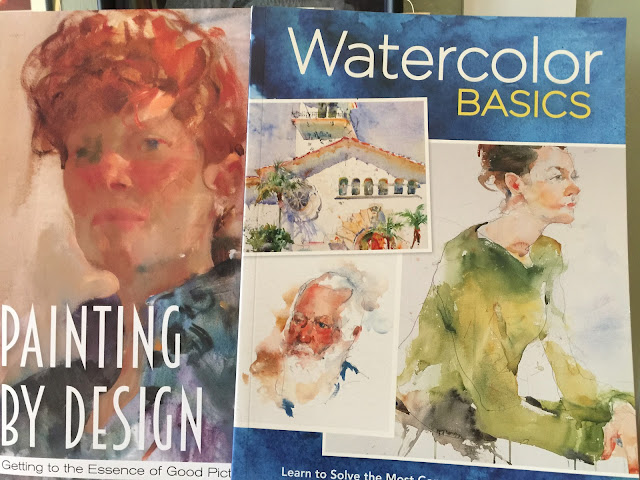
I brought two art books by Charles Reid, a master watercolor artist whose books and streaming videos, offer anyone the chance to learn from his detailed explanations of working with watercolor. 


I plan to read George Orwell's book Why I Write. The book was first published in 1946 and as with much of his writings still rings true today.


I picked two memoirs:
A Wilder Time by William Glassley, a geologist who explores the untouched wilderness of Greenland and makes his experience full of beauty and awe for the reader.

South Path by Raynor Winn, an Englishwoman who writes about losing the farm where she and her husband raised their family. They invested in a friend's business which failed, and they became responsible for his debts (a reminder to read the fine print on any contract), and ended up homeless. They also learned that the husband had a fatal disease. (and this isn't even fiction!) Without any moorings to lean on, they decided to walk from one end of the South Path Trail in England to the other (630 miles). The memoir explores the world they dropped into as walkers and as homeless, the reaction of others to their wanderings, and their realization of what is most important in their lives.

I also needed some good fiction:

Painted Horses by Malcolm Brooks is a favorite for this year.
The novel follows a young female archaeologist who is hired to document any signs of ancient civilization in an area in Montana which would soon be flooded by new dam construction. The dam would bring water to a parched area and employment to many locals. The land is near the Little Bighorn and is part of indigenous people's sacred ground. Lots of entanglements in the story.

And some good, easy reads:
I like mysteries so I included one of Martin Walker's Bruno, Chief of Police series, The Templar's Last Secret, set in a small village in France.
I've also picked up several books in the last year about bookshops. I found Jackie Fraser's The Bookshop of Second Chances delightful.

Happy Reading!


Friday, February 25, 2022

FOOD: AN OPENING TO FRIENDSHIP


I wrote this earlier this week before the news of Putin's invasion of Ukraine. I still think it is worth writing down. The Internet is awash with prayers, thoughts, and expressions of unity with the people of Ukraine. There are even protestors against the war in Russia. Let's hope this people-pressure will make a difference.


*****

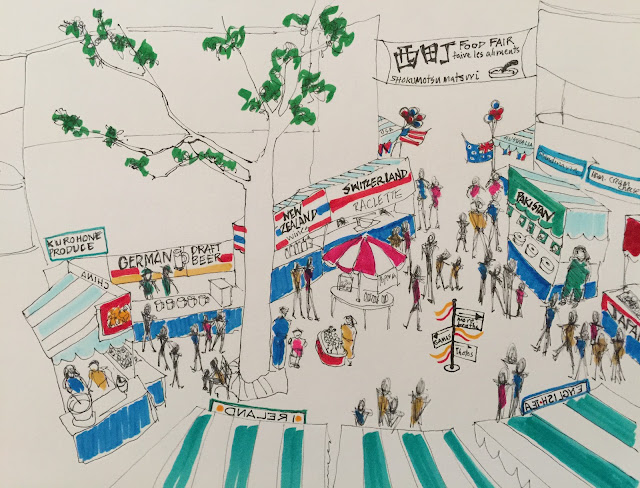
 In 2021 we hoped we would all return to a more quiet, less chaotic life but the recent news about Russia and Ukraine has raised anxiety levels again. The current events remind me, on a much smaller scale, of managing the Food Fair at our son's international school in Tokyo. The school included students from Japan as well as from all over the world. The fair took place in October when the humidity had dissipated and everyone had a chance to adjust to a new school year.

Running the fair was like leading a mini U. N. The fair was contained in the small schoolyard surrounded by the school's buildings -- not much room for over 30 booths representing 30 countries.  I had to deal with uptight parents, different languages, and different cultural expectations. Sometimes I succeeded, sometimes I didn't. My committee was composed of the same combination of mixed cultures. Nothing was done without a lot of discussion and debate. For instance, we had to decide where to put the Pakistan and Indian parents' booths so they weren't too close to each other because their two countries were often in conflict at the time. My most difficult moment came when I had to tell the Russian parents as they arrived to set up their booth that we had a misunderstanding. The money raised at the fair went to the school and not to each booth (a language barrier created the problem), and then I had to watch as they packed up their pastries and left. I thought of the so-called butterfly effect where one small action can ripple into larger waves.


The Aussies and American booths were opposite each other just outside the school's main entrance. These parents, besides the Japanese, were the largest contingent in the school and the loudest at the fair. Their many offerings attracted the attention of passersby. The Japanese booth, located inside the main entrance, offered Yakitori and ramen, and also a chance to try on a kimono or haori (men's traditional coat) for a photo. The Aussies cooked up lamb chops and sausage and steak sandwiches. The Americans made chili in large soup pots and barbequed hamburgers. They also secured, through the local army base, Pop-Tarts, candy, cereals, and all-purpose flour that weren't available in the Japanese markets and which satisfied the longing for food from home. The woman who agreed to order these supplies missed her deadline. I called her to confirm that she had completed the order only to learn later that her husband had committed suicide a few days before. My heart sank when I heard the news. I knew that living, working, and adjusting to life in another country can be a challenge for anyone. We arranged for someone else to take her assignment, but there was no way to cure her world of hurt.

A group of taiko drummers consisting of people from numerous countries marched through the schoolyard to open the fair. The drumming was an upbeat way to encourage people to play the games, eat the food, and mingle with people from all over the world who all had a common interest in the children at the school. It reminded me of a comment I hear so often lately, "Why can't we all just get along."

May we bring hope to the people of Ukraine today.


Friday, February 18, 2022

QUIET RABBLE ROUSERS

Under the Influence of Ben Shahn by Martha Slavin

Looking through old sketchbooks and art books reminded me of some of the artists who inspired me as a student. We imagine artists lost in the flow of creativity but they can also be quiet rabble-rousers through their art. I was captivated by these artists not only because of their artwork but because they stood up for justice and equality and used their art to express their ideas.

Ben Shahn, one of my favorites, lived through the prime existential moments of the twentieth century (1898 to 1969). He expressed his feelings and opinions through his art. He was both admired and persecuted for what he drew.

Shahn, born in Lithuania, emigrated with his family to the United States to join his father who had escaped from a Siberian work camp. After being bullied in school, Shahn turned to art to express his passion for justice. His topics ranged from the Sacco-Vanzetti trial (two immigrants who probably were wrongly accused of murder and executed), admiration for President Lincoln, the importance of registering to vote, support for unions, Eugene McCarthy's Peace run for the Presidency, and to more whimsical subjects as a little boy on a bicycle. In the 1940s and '50s, he was hounded by the FBI for the images and sayings in his paintings. He was threatened with deportation because his depiction of immigrants, workers, and civil rights issues did not illustrate "America the Beautiful."


Sacco & Vanzetti poster by Ben Shahn
(National Gallery of Art, Washington,  D.C.)


It is fitting that his alphabet design and his graphic style have become popular again in our anxious times. Recently, Cynthia Levinson wrote a children's book about Ben Shahn, titled The People's Painter, How Ben Shahn Fought for Justice with Art with illustrations done in Shahn's style by Evan Tuck. She describes his life and work and relates what Shahn once told Tomie de Paola, another well-known children's book author/illustrator. Shahn said, 

"Being an artist is not only what you do, but also how you live your life."


To order the book by Cynthia Levinson, go to:

While you are visiting Bookshop.org, place an order for Maus, A Survivor's Tale by Art Spiegelman

Both books are on backorder, but your purchase at this site will help independent book stores all over the country and make a stand against banning books.


Read more about Ben Shahn here:

Friday, February 11, 2022

ONE PHOTO, LOTS OF PAINTINGS


January 2022 version


Propped up on my easel is a small photo of a landscape with a large tile-roofed house nestled against sun-dappled hills. I found the photo in 2017 in a newspaper. Something about the way the ragged edges of the trees drifting down the hills in waves of orange and green intrigued me. Because I didn't take the photo, I don't plan to try to sell it or exhibit the finished painting. Watercolor societies have made a tough rule: any painting submitted must either be from real life (painted plein aire or from a still life) or from a photograph taken by the artist. Using someone else's photo, even with their permission, is copying someone else's vision. Tough rule but painters who have skirted the rule have been thrown out of an exhibition.


This photo has been a good practice piece for me. The photo is now wrinkled with age but still holds my attention. I have tried many postcard-sized versions, including painting the image once a day for a month. I have painted value studies, used dry brush strokes, and wet-on-wet. Remember these are just sketches.


I practiced painting clouds, I outlined everything and moved in closer to the house. 


Eventually, I set the photo aside and it got lost in the detritus of my workspace. I unearthed it recently and decided to try again. My latest version shows some of the skills I have worked on, but I will try again another day. Looking at all of the paintings together, I see that some please me while others will go into my junk bin to be cut up and saved for later use. 

Thinking of a way to use some of those cut-up pieces, I was inspired by a book about Paul Klee, who is one of my favorite artists. He worked in watercolor, used geometric shapes, and calligraphic lines. African art and contemporary artists such as Picasso and Kandinsky influenced his work. My piece does not look anything like a Klee, maybe more like Klimt. I'm still working on it. I'm not sure about the sky.


Want to know more about Paul Klee?

https://www.paulklee.net

 Gustav Klimt?

https://www.klimtgallery.org

 or Kandinsky?

https://www.wassilykandinsky.net


**************************

Good news for Contra Costa County in California: over 80% of the population has been vaccinated.

Just a reminder to stay safe:

over 900,000 people have died in the U.S. of COVID

in January 2022, over 82,000 people died in the U.S. of COVID (about 2700 per day and more than double the number of flu deaths in a normal year)

Hardest hit are the people who work with the public and who can't work from home. 

Let's keep protecting them.


Friday, February 4, 2022

VALENTINE SURPRISES


Our cat loves to be part of any activity

Do you have a special memory of Valentine's Day?

One Valentine's Day long ago turned into a marriage proposal from Bill. That's the end of the story. The story started early in the evening after a hard day of skiing at what is now Palisades Tahoe. We waited in line for two hours for a coveted table at a local, old-style Italian restaurant on the North shore that didn't take reservations and was hopping with other skiers ready to consume some hardy food and drink.

Once seated, we got into a heated discussion about the roles of a husband and a wife, differing in our opinions. In the end, though, Bill asked me to marry him, and I said, "Yes." After many years of marriage with all of its challenges and joys, I would still say, "Yes," to his question.

We will exchange cards on Valentine's Day. Sometimes, I make one from material I have on hand with the help of our cat. Other times I rely on store-bought ones. I've received in return a few handmade cards back from Bill.


Valentine's Day card from Bill


If you need some ideas, here are some quick Valentine's Day cards to make. 


All you need for the three designs are postcard-sized paper, small heart-shaped and square doilies, a collection of plain and patterned papers, raffia, glue, and some embellishments. For hearts, you can use a heart-shaped punch, your die-cut machine, or cut out the hearts yourself.

For each postcard, cut out a sheet of paper the size of your postcard. Glue it down to the postcard surface.
From your collection of papers, cut out 4-5 layers of paper, each one smaller than the last. Glue them down on the first paper. On postcard #2 (top right), make sure the last paper is plain. Set your postcards under a book to help the glue adhere securely.


Once the postcards are dry: 
Postcard 1 (top left):  Write what you would like to say inside a doily and glue it to the layers of paper. Tie raffia into a bow and glue it to the heart.

Postcard 2: Cut out the inside heart of the doily. Glue doily down on the plain piece of paper. Write your message on the plain piece of paper underneath the doily. Glue on a raffia bow and embellishment. 

Postcard 3: Cut out two small same-size rectangles. Cut out a heart from the metallic piece. Cut out a half-circle from a patterned paper and glue it to the other plain rectangle. Glue the plain piece to the background layers. Glue the metallic piece on top. Put under a book to dry. Attach a rectangular doily on top. Write your message on the center heart.

Place your postcards in an envelope to mail to your sweetheart or to someone who could use a little love. And remember whatever you do:


Friday, January 28, 2022

MORNING RITUALS

Sun Rising by Martha Slavin


 Do you have rituals that you follow each day? 

As I turned the page on my calendar, I saw a quote suggesting that little things add up to big ideas. In other words, small rituals can accumulate to provide a foundation for our lives.

A friend works the New York Times mini crossword puzzle each day. I do too. It helps me wake up and shows me if my mind is either sluggish or sharp that morning. If it's Thursday, I also do the two Cryptogram puzzles published in the San Francisco Chronicle. I have a cup of tea and then a latte before I start doing morning chores. Bill opens the back door and stands quietly on the deck for a brief moment before he returns to his day.  Another friend gets up early and walks up to five miles around town. A neighbor for many years walked at sunrise, stopped and prayed to the sun. All small rituals.


Fountain of Ideas by Martha Slavin


Our dishwasher has been broken since Halloween (too many spooky events last year?). Though the repairman has apologized profusely because the first replacement part was broken and the second was the wrong one, the dishwasher still sits waiting to be fixed. In the meantime, Bill and I wash and dry dishes, a small task that gives us a few minutes together. Bill developed "dishpan hands" in reaction to the soap we use, so now I do the washing with gloves on and he dries. Standing together, putting dishes away, walking back and forth around each other, we do what I call the kitchen dance. Small things.

We both retreat to our workspaces where I bring up a blank document on my computer and start writing snippets for my blog that have been circling around in my head during the weekend. Sometimes one snippet (like this one) will continue to grow. Other times I may end up with several starters that I file away in my Blog Ideas file, which now numbers 153 separate idea morsels. Some, such as Out of Time, Compost, and Myths to Live By, make me stop and reconsider their concepts. Others stay in the Ideas file because they ran out of gas in one paragraph, or I read what I've written and realized my writing doesn't have the point that I want to express. When people ask me if I ever get stuck for an idea, I can explain about my Blog Idea file that gets me going. Small rituals.

This week as I sit at my computer, I start writing about the sight of a young bunny outside our kitchen window. I want to draw or paint him, so I set the story aside. I watch the morning dogwalkers parade past my window. Often they stop and talk to each other as their dogs sniff and jump at each other. There's a story there somewhere. Then I move to the idea of how water and shadows change the shape of objects, but my thoughts end quickly on that one. Then I turn to a collection of tin wind-up toys that I am drawing. All of these ideas end up in my file for later. I go outside and walk around our yard taking photos of the colors of January and find new growth on shrubs and trees that are just starting to unfold in our out-of-season warm weather. I tuck that idea away too.


The Sun, Light as a Feather by Martha Slavin

All these small rituals that begin my week add up. I recollect the phrase that made our son groan sometimes when we reminded him of the Three P's: Practice, Perseverance, and Persistence Pay Off. He las learned that lesson well. Small rituals.

Friday, January 21, 2022

JANUARY TEXTURES

January first in California fools the eye. I  imagine people watching the Rose Parade see the spectacular blue skies and the craggy San Gabriel Mountains that fringe the Los Angeles Basin and are inspired to move to California. Blue skies or not, mornings in January can be cold, cold enough to do not much more than grab the paper and run back inside. I just have time to look over the ground to find January's small textures. Textures are the music in artwork. They create rhythm, patterns, and repetition that guide our eyes across the various parts of a piece of art or photography. 


Sights and Sounds of Winter Texture

 The scrunch of snow

Bare trees reflected in a puddle of water

The one-note whistle of a bird high in a bare tree

The crackle of dry leaves. 


The screech of a hawk staring down, feathers ruffled

The caw of a crow

Frozen sap from a dead tree


The rush of a swollen creek

The clatter of thin ice sheets splattered on the ground


The constant high-pitched whine of leaf or snow blowers

The flutter of chickadee wings

The sparkle of ice crystals hanging in the 20 degrees below zero air 

on a sunny day (in Utah)

The water foam around rocks as the rain-swollen creek cascades down


The snow tucked into cold corners

Lime green moss reaching around rock walls in California winter


Put these sights and sounds together and we have a concert of textures to enjoy.