Friday, March 17, 2017

HOW TO LEAD A SIMPLE LIFE


One of my favorite websites, HOLSTEE, asked writers to submit articles to their blog about the topic, Simplicity. Just the word itself sent me on a mental quest. What a wonderful idea to have a simple life, something most of us crave. Do you have a favorite way to make your life simpler?

I have a friend who is a wiz at decluttering her house. She has removed objects that no longer matter to her. Walking into her house feels like taking a breath of fresh air. Her art adorns the walls, and the furniture is arranged so that you want to sit, relax and have a long chat. The best part of a visit is opening the door to the back yard into a lovely garden with a 180-degree view of bay waters, hills, and Mt. Diablo in the distance.

I haven't learned her art of decluttering. I tried the trendy method of holding an object to see if I still feel any connection to it. No luck for me. Not only do I have a response to almost everything, but the object becomes a new distraction as I sit down and look through its pages or rub the sides of the teapot to bring back fond memories or wander through the stacks of art materials in my workroom. I can always find something interesting that keeps me attached to the object.

Do you work at simplifying your life in other ways? I found one helpful idea from The One Hundred Hours Project, which offers a card to manage time. The card has circles that I can fill in each time I spend an hour on my designated interest. When I have 100 hours accumulated, I can give myself a reward for the time I've spent doing something meaningful to me.

Produced using a Gelli-plate

I spent a week one summer at Scripps Camp, a retreat for alumnae from Scripps College. We stayed in the simply-furnished dorm rooms with just a bed, desk and chair. To my surprise, I accomplished a lot, even forfeiting opportunities to take workshops and to attend get-togethers with other alums because the room opened my senses to the quietness and stillness of the world around me. I wasn't thinking of a million different things like I do at home. I had time to listen to the silence.


I still struggle with how to carve out that kind of space in my daily life. Going to our local coffee house, sitting outside, and sketching people at other tables gives me a little of that freedom. Cleaning out my workspace helps too. Walking on the Iron Horse Trail opens my eyes to the natural beauty around me. Occasionally I work somewhere else in the house instead of my workroom, which offers me another perspective.


What do you do to live a more 
simple, more fruitful life?


Two good websites to explore:

HOLSTEE    https://www.holstee.com

THE ONE HUNDRED HOURS PROJECT   http://www.100hoursproject.com

Friday, March 10, 2017

LOYALTY

As a public school teacher, I was required to take a loyalty oath to the U.S. and California Constitutions. I didn't think much about it. I was used to saying the Pledge of Allegiance, the Girl Scout oath, and other symbolic words about honor. Other people have not been so quick to gloss over words that become superficial in their repetition. In 2008, a teacher in the Cal State University system was fired because she refused to take the oath for religious reasons. She was a Quaker and agreed to sign the oath if she could insert "non-violently" before the word support in the statement. (Read the statement below.) With media attention, she was rehired, but others who had similar religious objections have not been so fortunate.

I think about the oath now and realize that it was instituted during the McCarthy era in the 1950s to eliminate teachers who belonged to the Communist Party. (The oath, because of court decisions, has been revised to exclude firing because of membership in any club or organization.) I am part of the white privileged group in the U.S. who doesn't often experience the fear that can erupt when questions about our thinking, our origins, our family history, and/or our political positions arise.

Before I was born both my parents worked for Disney Studios until shortly after my dad's cartoon students joined striking artists at Disney in 1941. Disney thought my dad encouraged his students to strike. My parents left the studio and moved to Vermont where he worked as a freelance cartoonist and as an engineer in a New York company. When they returned to California, he began working for Western Publishing Company, which contracted with Warner Bros. to create the Bugs Bunny comic strip and books.


A cartoon that appeared in the company newsletter where
my dad worked as an engineer for a short time during WWII.

Many people involved in the entertainment industry were denounced, even without proof, to the House Un-American Activities Committee during the 1950s. My dad was a widely-published comic strip artist by then. He knew of one artist who couldn't find work because of suspicions about his loyalty. My parents worried about the threat of being accused of being members of the Communist Party, even though they were not politically active. I remember as a child feeling that fear from my parents.

One Saturday my family climbed into the car and drove to Alhambra to shop. My dad, as he usually did, left the car unlocked with windows open. When we returned, a flier had been thrown on the front passenger seat. My mother picked up the paper, which was an invitation to a Communist Party gathering, and hid it under her purse. At home, she put the flier on the entry desk with the intent of disposing of it later. Before she had a chance to do that, a friend came over. The flier was still on the table though no one mentioned it.

When the friend left, I remember the look of fear that crossed my parents' faces when my mother picked up the flier off the table. If the friend reported seeing the invitation, my dad could lose his job. Luckily for them, the friend either didn't see the flier or didn't care. The incident was soon erased when the paper was torn up and put in the garbage. But that sense of fear has never left me. I had an inkling of what some people live with every day and I haven't forgotten that.


My dad loved to draw horses and the freedom they represented.


"I, _________, do solemnly swear (or affirm) that I will support and defend the Constitution of the United States and the Constitution of the State of California against all enemies, foreign or domestic; that I will bear true faith and allegiance to the Constitution of the United States and the Constitution of the State of California; that I take this obligation freely, without any mental reservation or purpose of evasion; and that I will well and faithfully discharge the duties upon which I am about to enter."

******************


In 2013, two artists from Britain went to Normandy to commemorate International Peace Day by marking the beach in honor of the men who were killed during D-Day of World War II. 
Their blog, reached by clicking on the link below, describes what they did: a beautiful example of caring about sacrifice, loyalty and honor.


SaveSaveSaveSaveSaveSave

Friday, March 3, 2017

LETTERS: AN EXPRESSION OF CULTURE


My apron along with some of the name tags from calligraphy workshops

I put on my new apron, spread out my tools on my table and prepared to test my calligraphy skills to the maximum while I attended LETTERS: California Style, a workshop conference sponsored by the LA's Society of Calligraphers. At the end of a glorious day of working, wandering the conference center halls at Cal Poly, Pomona, gazing at incredible pieces of calligraphy, and rubbing shoulders with artists from all over the country, I walked outside. Rain poured down, my cheap, orange umbrella would not close when I tried to get into my car, I was thoroughly soaked by the time I returned to my hotel where I had to walk around the flooded carpeting to get to my room. But I woke up to sunshine ready for another day of practicing Copperplate, a traditional lettering style, which we worked to turn into more modern forms.


My pages of practice and my writing tools,
which include a potato to clean off the pen tip and a bar of chocolate


Using my own handwriting to develop an alphabet


Serendipity happened to me at the conference. I was on the waitlist to attend so my choice of class was limited to one. I say serendipity because I normally would not have chosen a class that depended on my skills in any calligraphic alphabet. I don't call myself a calligrapher. I've had a lifelong interest in type and letterforms, but I have not been consistent in practice. I usually select classes that allow me to be more free form. This time I spent three and half days in Jane Shibata's "Breaking with Tradition: Cool and In Vogue Pointed Pen Scripts." In Jane's class, we bent over sheets of paper with pointed pen from early morning to the end of the day just like scribes did long ago. Jane's class turned out to be one of the best I've taken since it forced me to concentrate on my lettering skills. Jane is a gentle, kind instructor who patiently offered suggestions and encouragement and talked about her own experiences as a student and teacher.


Jane Shibata demonstrates adding colored pencil to letters.


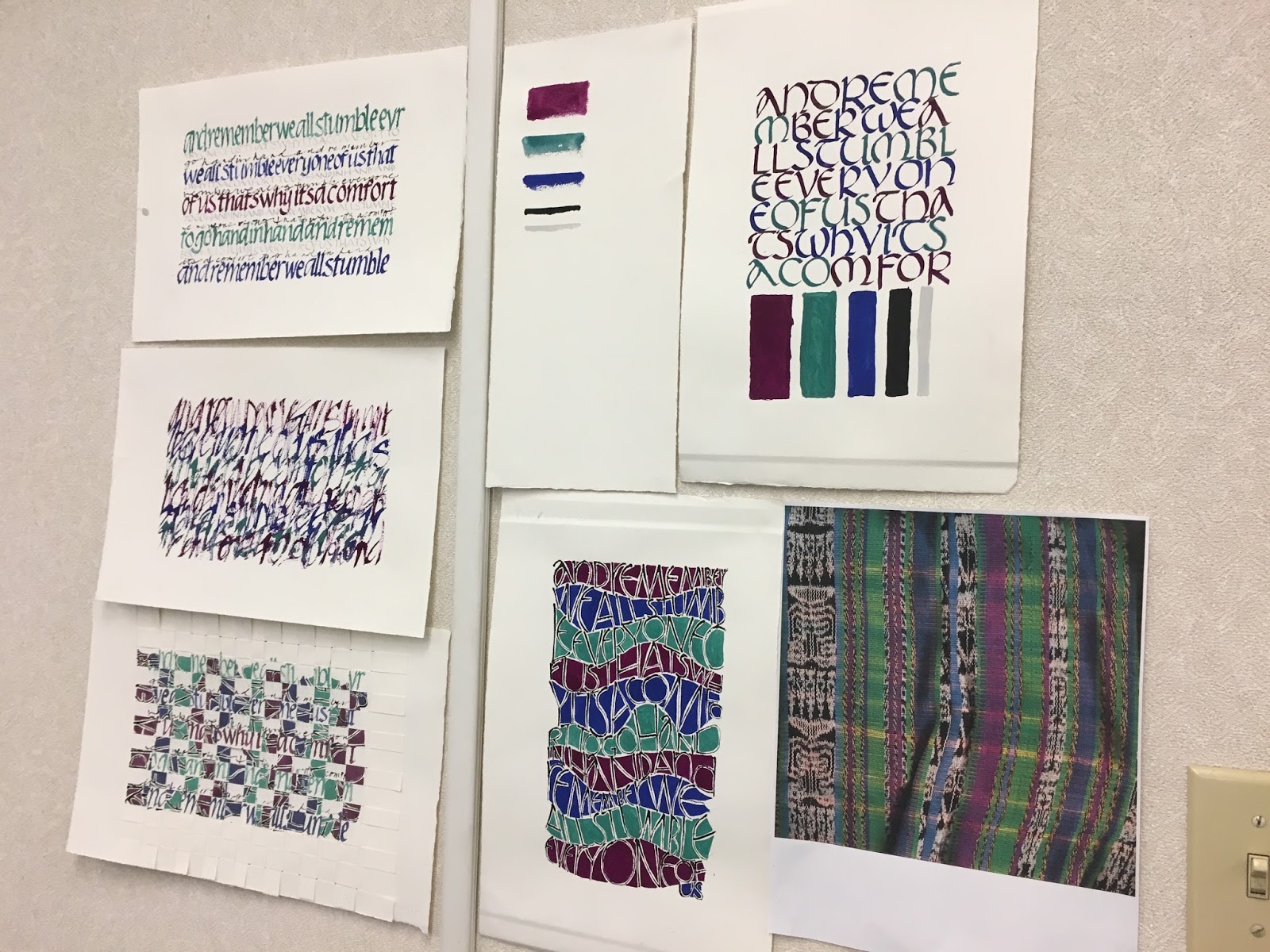
Marina Soria, one of the other workshop teachers, encouraged her students to produce calligraphic work based on a piece of weaving. I was reminded of one of my college professors, Douglas McClellan, who talked about the influence of weaving on the development of letterforms. Without the examples of crossing threads in weaving, he claimed that we would not have the alphabets we use today. He gave us the assignment to design an alphabet for an alien culture that did not weave. Good question: what would an alphabet look like that did not have lines that crossed?  Dots, dashes, perhaps? What would your design look like?

Examples from Marina Soria's class. Photo by Linda Yoshida

Friday, February 24, 2017

SEND POSTCARDS


Postcards are back. We inundate our representatives in Washington, D.C., by sending small postcards with pithy messages and a call to action. I've started sending my reps cards from the National Park System as a reminder what great people of other times created when they set aside their personal gains to designate land so that we all could enjoy the natural wonders of the United States.

A group in a recent calligraphy class plan to mail postcards using their calligraphy skills to draw attention to their messages. Just as the Tea Party grew at the beginning of the Obama presidency, opposition to Trump has reawakened a new group of people who are banding together to make sure their voices are heard. One of their first actions has been to flood the hallways of government with postcards. Such a simple, yet powerful, act.

Postcards used to be part of our travels around the country. When we stopped along the way, we picked out favorites, wrote a short message and sent them to friends. I still have boxes of them in my workroom from other people's travels. Sometimes I use them in a mixed media piece; but mostly, I turn them over and re-read the message on the back from a friend.

A postcard printed by Lantern Press. www.lanternpress.com
They produce beautiful art postcards that can be found
at Amazon, Zazzle, and Art.com


In my Wednesday Writers group, we challenged ourselves to send each other postcards over the summer vacation. I sent cards to my fellow writers and to other friends as well. From this small action several years ago, I came up with the name for my blog, Postcards in the Air.


postcards designed by Beth Wheeler & Misako Osada

I continue to send postcards, not just to my representatives. Recently I've subscribed to online postcard exchange groups and have 'met' some new people across the country.

Jennifer Belthoff, a writer and blogger, leads a group called Love Notes. She says, "Opening our hearts & sharing our stories is the key to connection.We shine brighter when we stand together."

Kat Sloma of Kat Eye Studio offers the Liberate Your Art Swap to encourage you to reproduce your own artwork as a postcard.

Louise Gale coordinates The heART Exchange to encourage self-care, gratitude, and creativity.

Here are some of the postcards I've received from these groups:

by Lynda Fishburne at Smilingbluefish.com
postcards by Chandralynn and Sharon Minchuk


You can find these exchanges at these links:

Jennifer Belthoff:  www.jenniferbelthoff.com
Kat Eye Studio:  http://kateyestudio.com/about-the-kat-eye-studio
The heART Exchange: http://yourheartmakesadifference.com/heart-exchange/


Good places to find  quality postcards:

Syracuse Cultural Workers  https://www.syracuseculturalworkers.com/

Max & Co. Post http://store.maxandcopost.com   (a Lantern Press dealer)

Friday, February 17, 2017

LIFE IS....


My answer to that statement?

Life is a challenge
Life is a test or a series of tests
Life is wandering from one thing to another
Life is difficult
Life is beautiful
Life is so daily
Life is finding authenticity
Life is full of unexpected surprises
Life is open to suggestions
Life is the quiet time between busy activities

What is your answer?

My favorite choice: life is a series of challenges.


Grab a pencil and join me in a new challenge. I've signed up for the Sketchbook Project hosted by the Brooklyn Art Library. Over 35,000 people have submitted sketchbooks to the project run by the Art House Projects. They digitize the books so that you can view them on line. You could also visit the library in Williamsburg, Brooklyn, to see the real work. 

Remember that all of us has an artist within. Drawing and writing out your ideas helps to develop your creativity. Go for it! Take a chance and accept my challenge.

Some of my favorite pencils. I've had the mechanical pencil since college. My new favorite is the fat pencil, second from right.


Your sketches, doodles, and words on paper gives you 
a quiet, yet effective way to be an artist
and to reach out to other people with your ideas.

Brown sketchbook from the Sketchbook Project

I just received my plain brown sketchbook from the Brooklyn Art Library and I've started filling it up with sketches and writing.
Come and join me. Grab a pencil and begin!


As you can see, I have several sketch ideas going on throughout my book. The top line consists of words. The second line is full of faces from places that I go. The third line is random items that I see or witness. And the last line is trees, so far. If you feel stuck for an idea, go outside, find something that interests you, and describe it. What color is it? What is its shape? What size? What kind of shadow does it make? Is it smooth or does it have texture? Try a contour drawing of it: look at your object while your pencil is moving slowly on the paper. Look at your drawing only when you come to a corner. Draw just the edges. Don't do any shading.


Anyone who wants to complete a sketchbook needs to buy one from the Sketchbook Project website. You will receive a small brown book with 32 pages, just enough to do one sketch a day. Fill it up and send it back to them by the deadline. Mine is April 15. Yippee, I have a little more time to fill up all those white pages that I have just started on!

https://www.sketchbookproject.com


Friday, February 10, 2017

WALKING THROUGH RAIN DROPS

Images by Bill Slavin
 Walking up the street, I see the flowers of our early Spring: daffodils, camellias, primroses, and the tiny pink flowers of Manzanita and Sweet Breath of Heaven. These flowers keep coming back each year, even though they are buffeted by wind and rain, their petals turn soggy and brown, and they fall and become mush in the mud. I marvel each year at their persistence against such adversity. They are a reminder how fierce and gentle Nature can be.


Our rain gauge shows four inches of water since last Sunday. After five years of drought, we have rain.The creek in our neighborhood, fed by water coming from the hills around Mt. Diablo, wanders behind the houses across the street. This year we can hear its roar from our house. Slides and fallen trees result from the heavy downpours that saturate the ground. We have the deluge of rain that was promised last year. The Sierra Nevada snowpack measures over 435 inches in many areas. (The average is 450 inches for the entire year.) We enjoy winter sports again.

California cycles between drought years and rainy years. It is so easy to relax and return to old bad habits. I find myself leaving the water on too long already and I have to remind myself to conserve even with the rain. If you are like me and grew up in California listening to the stories about the Owens Valley (watch the movie Chinatown), the first Gov. Brown's Peripheral Canal, the continual tension between North and South about water rights, and the struggles between farmers, city dwellers, and the fish and animals that also live in California, you know that we are all intertwined, dependent on each other. That's easy when we have abundance. Then it is easy to share. Water makes us feel clean and when it runs out of a faucet, easy to waste. Some people want to lift our current stiff restrictions on water use. Instead, we need to step back and work together to change our mindset permanently to use only the water we need.


Friday, February 3, 2017

PROTECTING WILD


First we needed chains.

A trip to Yosemite reminded us how seldom we ventured into the wild. We had to dig through our drawers to find our winter wear, shop for new sturdy boots, and we needed chains. We used to ski at Squaw Valley almost every weekend in Winter, often stopping during a snow storm to put on chains. The snow sometimes piled up 20 feet against the houses, we skied through 40-to-60 mile an hour blizzards, our faces bitten by the cold wind, our eyelashes and facial hair thick with ice drops, and our fingers and toes burned from the cold. Those times were as wild as I've ever been.


I've been reading The Wild Places by Robert MacFarlane, who set out over a couple of years to find the wild places in Ireland and England. He swam in icy waters, hiked and slept through blizzards, trudged to the tops of mountains where he felt the indifference of the natural world to his solitary existence. Yet, everywhere he went, he walked where others had been walking for centuries. He finally discovered a truly wild place when he looked down a gryke on the Burren in Ireland. A gryke, a word I had never heard before, is a crack in limestone. Lying flat, staring down into the gryke, MacFarlane saw a wild world where seedlings had drifted and competed for space in a miniature rain forest. His glimpse of that world reminded me of a valley near Mt. Herman in the Santa Cruz Mountains. On one side of the steep hills was a camp bustling with people. But walking down a winding trail, I emerged in a rain forest filled with a rushing creek, tall redwoods, ferns, and other vegetation that grew with vigor under the tall trees' canopy -- a wild place.


I have friends and relatives who often seek the wild: women who ride motorcycles, hike along the Pacific Coast trail, climb Half Dome, kayak in deep water, and walk in Shackleton's footsteps in Antarctica. They push themselves beyond their anxiety. Skiing in the Sierra often reached that deep spot inside me where fear originated. Each time I ventured out on a blustery day, my subconscious would conjure up the image of a 5-year old girl stranded in the middle of an ice rink, ripe with dread, not knowing how to move with grace, expecting to fall and hurt myself. After what seemed a long time, with the help of a kind stranger, I made it over to the rink's edge. Skiing was like that. I had many miserable times out in the snow, standing frozen in fear until the cold would force me to turn down the mountain. But I didn't stop skiing either. I kept practicing. Eventually, with great joy, I could shimmy down moguls as tall as I am and could ski down all the runs at Squaw except the West Face of KT22. I tried that once. I stood at the top of the run and looked down. My skis hung over the edge, the mountain leaned in on itself underneath. That first step was too much for me and I turned and went down the easier East side. Sometimes you have to know when to back away.

We often live in fear: fear of the other, fear of the unknown, fear of the wild and fear of our own shortcomings. Being out in the wild, in the snowstorms, on steep mountain trails pushed me as far as I am ever likely to go, but I am a better person for trying.


Some people have destinations on their Bucket List. My list includes this first one: being in the wild once more. So, we trekked to Yosemite in our car equipped with chains (that we didn't use), with our new boots, our ski hats and gloves, and warm coats. We were greeted by the sunset on the top of El Capitan, by the quiet, snow-laden valley, by a managed wild place that is enjoyed by so many that there are signs to stay off the meadow to protect the native grasses from being trampled. Another sign stood tall to indicate the height of flood waters in the valley. Away from people, we could hear the crash-boom of huge blocks of snow that cascaded down the sheer cliffs. The sound echoed through the valley like an explosion, reminding us that we were also standing in an unmanaged wild place.

Does the wild tempt you?


This week's post is dedicated to Fred Korematsu, an American of Japanese descent, who challenged Federal Order 9066 during World War II. He wasn't afraid to stand tall in his beliefs.