Thursday, July 24, 2025

KEYSTONES


When our son was very young, we would walk up our street after a rain, and I would pick up every earthworm I found wiggling on the wet pavement. I'd place them back on the yard on the other side of the curb. Our son was more interested in the trucks, graders, and backhoes that stood on empty lots that eventually filled with houses. No sign of earthworms on the packed, damp ground there.

Recently, Scientific American called earthworms keystone species that are necessary for human survival. They do the work of churning up the earth to allow something to grow. Taking the walks up our street made me more aware of what's beneath our feet. It was almost easy to miss the rattlesnake up against the curb. A car had run over it and left little life in it anyway, but I still jumped away when I glimpsed it out of the corner of my eye. 

Sitting in a small cafe in a small town on the other side of Mt. Diablo, I noticed a swarm of bees buzzing in and out of several flowering trees. Walking along the streets of San Francisco, I discovered brass plaques with snippets of poetry engraved on them embedded into the street. Who would have thought that poetry would be planted in our streets? 

I've been reading Walking, One Step at a Time by Erling Kagge. He describes walking as a way to slow down the passage of time. I agree. Traveling by car or plane makes us rush time. On a plane flight, we begin in the morning and quickly pass from morning to afternoon or night. In a car, I would have whizzed by the bee-filled tree or been the one to run over a snake. Instead, as I walked, I could take a moment to realize what else was around me.  I would not know what it feels like to walk on volcanic rock or wet sand or pebbly beaches either. 


During my childhood, my family took trips to Minnesota, San Diego, Northern California, Lake Tahoe, and the Sierra, all by car, but slowly. We didn't rush. We didn't have hotel/motel reservations. We would stop in a small town when my dad grew tired of driving or when we clambered to stop at a souvenir shop to buy postcards or found a storefront "museum" filled with pioneer treasures. We explored places we deemed "mother's shortcuts," ones that my mother discovered on a map or that my dad had read about in his many Western novels. 

My parents chose three different routes to Minnesota. They all started on Route 66, but took other highways to get through Arizona, Utah, or Colorado. On our most southern route on Highway 40, we passed through Hopi and Zuni reservations with towns named Tohatchi, Chinle, Fort Defiance, and Window Rock, which piqued my interest in our shared and bloody history during the great migration west in the 19th century. On our most northern route, we drove to Salt Lake City and turned to the northeast to cross the Rockies. We descended to the prairie, where the borders of reservations appear on maps as mere fractions of the land that was once all Native Tribes. We stopped in the Black Hills to see Mt. Rushmore, with its depiction of four of our best presidents. We also heard the stories of Sitting Bull and Custer at the Battle of the Little Bighorn, and of Red Cloud, whose alliance with other tribes resulted in the only defeat of the U.S. Army until modern times. We made a stopover in Pierre, South Dakota, to see one of our relatives, and then we traveled through the Badlands with its stark landscape. When we reached the border of Minnesota, the landscape changed again with cornfields lining the road. The earth in Minnesota is rich, dark brown, and fertile, and crumbles in our hands. In the mining areas in the north, the ground becomes deep iron-red, full of minerals and ore. We wouldn't have noticed any of these sights from a plane.

On recent trips to Minnesota, we've stayed on a lake in the middle of the state and listened in the early evenings to the loons' call and the wolves' howl. The wolves, making a resurgence in the Great Plains and keeping the herds of elk to a size that doesn't destroy other natural habitat, are another keystone species, just like the earthworms.

Summer flowers in Minnesota


***************

Don't miss the documentary, "Sunday Best, the Untold Story of Ed Sullivan," on Netflix. 

As a kid, I would watch the program with my family, but I never thought about what Ed Sullivan brought to TV. The leaders of CBS and Paramount of today should remember this show and Edward R. Murrow's See It Now as shows that represented the best of our culture and of standing up for principles of democracy. 


Friday, July 18, 2025

BACK TO BASICS

By Martha Slavin


After spending most of spring dealing with our possessions and only making time to sketch when I sat in a cafe or on a park bench, I can finally return to my daily art practice. I always call what I do Practice to allow myself to relax, not worry about mistakes, and to know that the piece in front of me is not so important that I can't try again. My life as an artist would be different if I depended on an income from my art. As a commercial artist, I would need to meet the buyer's requests and not be focused on my own expression. Instead, I'm free to experiment and to fail. With watercolor, I have a host of those failures; not every piece is worthy of a show or to be framed. I cut my discarded paintings into either strips or one-to-two-inch squares, which I adhere to a larger piece of paper. Sometimes I align them like quilt pieces; other times, I let them fall and glue them down where they land. Every watercolor has some parts that work very well, and there are always parts that don't. Cutting them up and re-purposing them has given me the freedom to see new possible pieces. I find I use them as a base for calligraphy too. I haven't figured out a good phrase for the Squares & Circles below. Any suggestions?


Squares & Circles by Martha Slavin


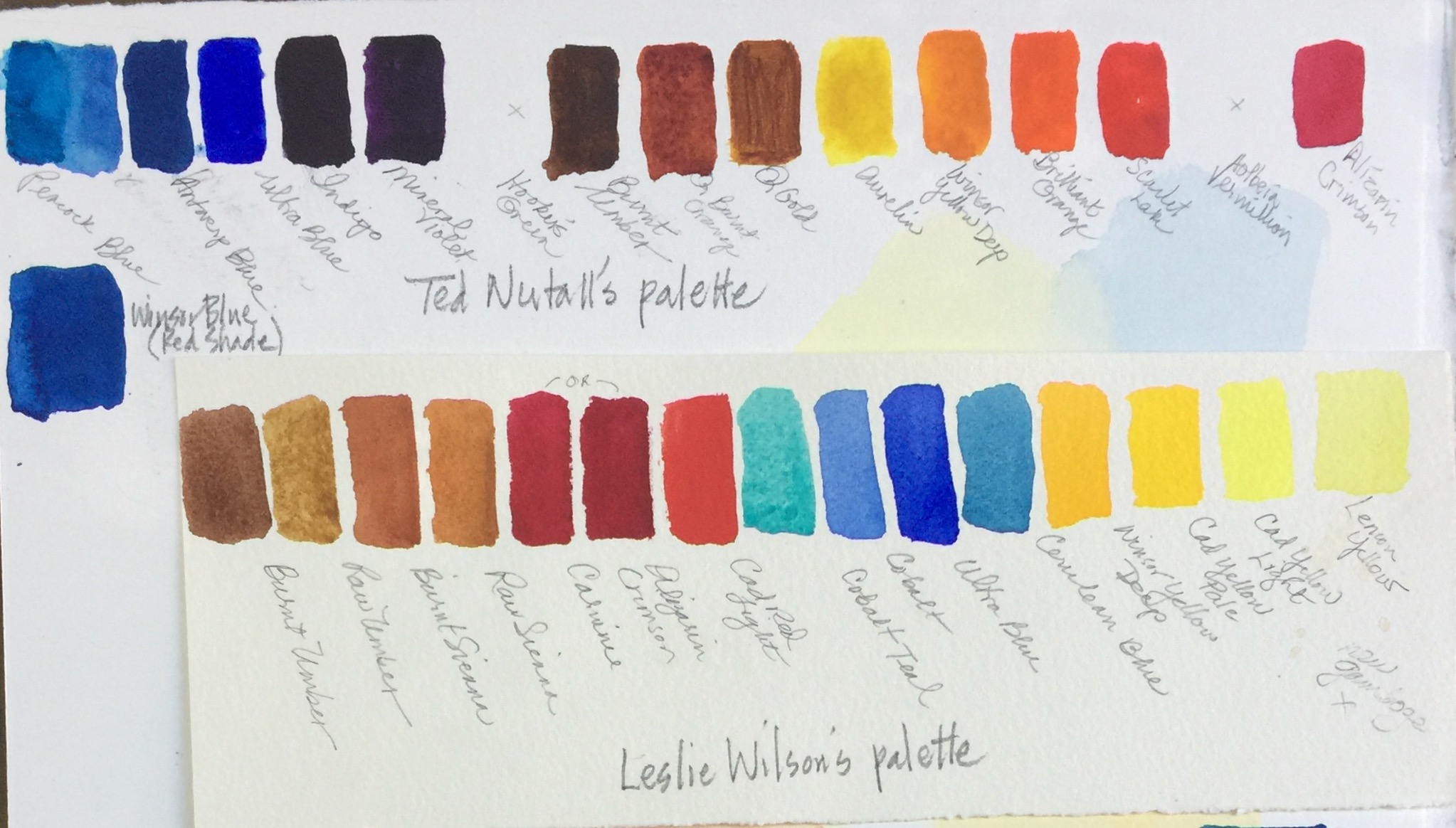
I'm once again an active participant in watercolorist Leslie Wilson's watercolor class. She teaches the direct painting technique, which is quite different from how I originally learned watercolor with built-up layers of paint on damp paper. Her techniques are adapted from Charles Reid and make use of hard and soft edges, mixing colors directly on the paper, and contrast between darks and lights. My first attempt in class turned immediately into one-inch squares as soon as it was dry.

I've gone back to basics by doing small watercolor sketches instead of the half-sheet watercolor paper that I use in class. With the smaller paper I can let go of any fear of messing up and just concentrate on small parts of the sketch. Notice I say sketch, not painting. Sometimes those sketches develop into a good-enough painting; other times, they just become part of my sketchbook that I can close when I'm done. Like creating a palette of colors, small paintings allow me to think to myself: "Practice, practice, practice, with work that I hope I can carry over to larger pieces once I have my 'watercolor mind" back.


Two different palettes from two different watercolorists,
Leslie Wilson and Ted Nutall


***************

Charles Reid died in 2019 and doesn't have a website that displays his work. Check out his book on Amazon instead:  https://www.amazon.com/Watercolor-Basics-Common-Painting-Problems/dp/144030131X/ref=pd_bxgy_thbs_d_sccl_1/147-5429064-3243507?pd_rd_w=D9L2N&content-id=amzn1.sym.dcf559c6-d374-405e-a13e-133e852d81e1&pf_rd_p=dcf559c6-d374-405e-a13e-133e852d81e1&pf_rd_r=RH22FWXKXCHSGCTVBF9N&pd_rd_wg=i4R2B&pd_rd_r=8ce8f234-5c35-4cd3-a3c5-70b8d2d87006&pd_rd_i=144030131X&psc=1

Ted Nutall:  https://www.tednuttall.com

Leslie Wilson: https://www.lesliewilson.net


***************

Calligraphers are not like what you imagine them to be. Check out the examples produced by the Pacific Scribes guild:

https://pacificscribes.org/gallery/ 

Thursday, July 10, 2025

TRAVELING BY BOOKS


Jostling inside one of the old streetcars that rumble and clang down San Francisco's Embarcadero, we viewed the rebirth of tourist season in our town. We saw lines of people waiting for the Alcatraz ferry, lines for lunch at the Ferry Building, and groups of people walking to Oracle Park for a ballgame.

As a native Californian, I am aware of the fascination with California. One set of grandparents came west from Elmira, New York, during the 1920s. My dad and some friends drove across the Plains from Minnesota on their way to jobs at Disney Studios at the end of the 1930s. Bill's family started in Newport News, Virginia, with lengthy stops in Cincinnati, Ohio, and Decatur, Illinois, finally arriving in Los Altos, California, during his high school years. All of us, immigrants from somewhere else.

Sunset Magazine, first published at the beginning of the 20th Century by the Sunset Railroad, enticed people to come. The magazine showcased the different cultures that had influenced California's lifestyle. The magazine filled its pages with California artists such as Dong Kingman, Earl Thollander, and Millard Sheets, homes designed by Clifford May and Joseph Eichler, and recipes that fit California's outdoor life. Sunset created covers advertising the state, using design elements similar to those found in the paintings and prints of Henri de Toulouse-Lautrec. Bold colors, large areas of open space, and strong outlines of shapes made the West appealing to many. Because outdoor living was central to California, Sunset created ideas and books that catered to western gardens. We purchased our first home and depended on the Sunset Western Garden Book for inspiration and advice.


When we moved to a high-rise in San Francisco, I finally gave away our gardening book. Like a recipe book, it was filled with notes and scraps of paper with ideas for a garden. In our new home, we have no place to plant; instead, we look down on the tops of Japanese maples, cherry trees, and the greenery that is taken care of by others. A circular fountain stands in the middle of the driveway leading to our building. We are tempted to drop a few goldfish into the fountain, but restrain ourselves. We've discovered that the plantings around our building change with the seasons. The trees change color and drop their leaves in autumn. The first camellias bloom at the beginning of winter. The azaleas and Pacific Coast iris appear early in the spring. And roses surround the island in the middle of the fountain as summer advances.

Traveling has been off our list while we spent two years moving from one place to another. But California does have its charms, even for a native, and we've decided to spend our time exploring more of the places we haven't seen in the state. 


California has been the subject or setting for many books. Writers as different as Bret Harte and the poet Charles Bukowski created work influenced by their time in California. The non-fiction books that I've posted here are all meant to be read and savored in short doses. Rebecca Solnit dissects the layers of San Francisco, and John King, the former architecture reporter for the SF Chronicle, tells the story of the rise, fall, and resurgence of the Ferry Building. Sylvia Linsteadt writes about hidden places in the Bay Area. California Calls You and Back Roads of California are filled with rich illustrations of the beauty and allure of California.


Check out this California state website for a list of books written by Californians:

https://www.library.ca.gov/wp-content/uploads/2021/08/ClassicsByCaliforniaAuthors.pdf 

Friday, July 4, 2025

TIME TRAVELS


Window View July 2025


A hundred years. A century of life. My grandparents and parents were alive in 1925. They had already witnessed the spreading of electricity, indoor plumbing, the telephone, and motorcars, as they were called at that time. One hundred years ago, the world had survived the First World War and the 1918 influenza. Virginia Woolf's Mrs. Dalloway, Franz Kafka's The Trial, and F. Scott Fitzgerald's The Great Gatsby were all published in 1925. All three books remain on Literature reading lists, and their themes are as pertinent today as they were when they were first published. Fitzgerald memorialized the idea of how great wealth and prestige can corrupt and decay morals and social values. The Trial showed us that an individual can become powerless against an overreaching form of government. Mrs. Dalloway's themes revolve around the passage of time and the effects of WWI, especially on class structure and privacy.  These ideas are so familiar today.

One hundred years ago, the Jazz Age and Paris were filled with creative people such as Ernest Hemingway, Henry Miller, Picasso, Man Ray, and Josephine Baker. New fashion design created freedom of movement for women. Coco Chanel promoted the flapper dress with its tube-like shape and shortened hemlines, and hair cut into a "Bob." The right to vote was extended to women in the United States. Jazz became the music that represented these forms of rebellion against norms.


Fify-one years ago, the Beatles arrived at JFK Airport after their song, "I Want to Hold Your Hand," went to #1 on USA charts and helped to create another music rebellion. While traveling around the US, Paul McCartney took photos of all the people who came out to see the Beatles. A large collection of his photos, along with several videos from TV appearances, can be seen this summer at San Francisco's deYoung Museum. Amidst all the frenzy that surrounded the group, McCartney stepped back and took pictures of crowds waiting on roofs, on streets, and at airports. We wondered if anyone in recent years has created such a fan frenzy, and thought of Taylor Swift, who has created a devoted fan base through her music.

The Beatles' music outlasted the group. Their early music is catchy and easy to sing along with, and it played as the background to my own early adulthood. Along with groups like the Doors and the Righteous Brothers, Beatles' music rang out at every college dance. We still hear their music in public places, and children have grown up listening to them, too. Yesterday, as I walked through a shopping mall, I was surprised to hear "Help" over the speakers.


A friend, who is organizing music shows at the Winters Opera House, invited us to a performance by the Sun Kings, a Beatles tribute band that has been playing together for 25 years. Winters is off the main highways, between the Bay Area and Sacramento. Bill and I had never been in Winters before, so we were curious why we had missed it. As we headed east, we drove across the Bay Bridge to the Carquinez Straits to Highway 80, a road we traveled often in earlier decades to go skiing in the Sierra Nevada Mountains. At that time, Highway 80 was a country road that cut through fields of produce, and almond and walnut groves. Fruit stands dotted the highway, and an occasional way station, such as the Nut Tree, offered a place to stop on our way to the Sierras. Now, until we reached the Nut Tree, shopping malls lined the road, though large swathes of farmland can still be seen behind the buildings.

After we passed the Nut Tree, we took Highway 505 to Winters, a small town where everyone seems to know each other. 2025 is Winters' sesquicentennial year (150) and the town is still flourishing. The main street is only a couple of blocks long and lined with old, stately brick buildings, attesting to the town's prosperity in the previous century as a hub for railroads and agriculture. The railroad no longer stops in Winters, but agriculture is still a big business in the area, and several large corporations near Winters provide other jobs. Three lively restaurants in the center of town occupy some of the brick buildings: the Preserve, whose owner sponsors the music shows, the Buckhorn Steakhouse, and the Putah Creek Cafe, which has a line out the door on weekends for breakfast. The Hotel Winters has been beautifully refurbished and is across an alleyway from the Opera House, where the Sun Kings performed.


That evening, the hall quickly filled with ticket-holders, most of whom had been around in 1964 when the Beatles performed on the Ed Sullivan Show during their first tour of the U.S. We heard a few screams when the band started playing, "I Want to Hold Your Hand."  During the first half of the performance, we listened to the merry, light-hearted music that the Beatles played in their early days. The whole room moved with the music, singing along to every word just as we all did in 1964. After the intermission, the Sun Kings moved on to play the Beatles' more sophisticated, intricate music and ended with John Lennon's ballad, "Imagine." Those songs from the earliest to the later years moved us through a decade of turbulence as we witnessed the Vietnam War and Watergate. The later songs reminded us of the effect of those events on the world, how that music helped to carry us through those turbulent times, and how much we have changed since then. After a week, I am still humming "Can't Buy Me Love."


All Americans' Day


Check out Litcharts for more information about these three great books:

https://www.litcharts.com

or 1920s Fashion:

https://www.wardrobeshop.com/blogs/flapper-era/how-jazz-influenced-fashion-in-the-1920s#:~:text=The%20Age%20of%20Jazz%20in%20Fashion&text=.The%201920s%20saw%20some%20massive%20changes%20taking%20place%20in%20the%20fashion%20industry&text=Some%20significant%20changes%20that%20became%20permanent%20in,make%20moving%20around%20and%20driving%20cars%20easy

Winters as a place to visit:

Stay at the Hotel Winters:

https://www.hotelwinters.com/?utm_source=google&utm_medium=local&utm_campaign=gmb_listing

Try these local restaurants:

https://www.preservewinters.com     

https://www.buckhornsteakhouse.com   

https://www.putahcreekcafe.com  

Interested in music? Check out the Winterslive concert list at 

https://www.preservewinters.com/live   


Friday, June 27, 2025

CONNECTIONS


A walk through a garden gate


Last Saturday, Bill and I attended a live podcast produced by Village Connect, a local non-profit with a mission to support families, schools, and individuals by developing cultural connections. The event was staged in a local church, which had been renovated with white walls everywhere, while still retaining the original stained glass windows that brought colored light into the room. It was a beautiful space.

I've spent many a Sunday throughout my life sitting in a church. I am not a religious person anymore, having given up Christianity when the extreme right took over back in the late 70s. I had to step back and examine my own beliefs when I repeatedly heard words and ideas that I didn't believe in. That doesn't mean that I have lost my love of churches. I find walking into one gives me a moment of stillness and quiet that I don't experience in a museum or other monumental place.


Angel in an old church in Norway

We sat in comfortable padded chairs positioned so that each person had plenty of room to walk down an aisle or place their possessions around them. The back of each chair had two pockets: one for donations and one for a pamphlet about the church, but no Bibles or hymns. Sitting, while we listened to the podcast interviews, I thought of other seating in other churches in my life. As a child, my family attended a local Methodist church, which met in a small traditional Gothic-style chapel with stained glass windows lining the stone walls. The church was dark and lit by candles. The pews were wooden and hard. A pew-length pocket contained a hymnal, a Bible, and envelopes to put in donations when the brass plate came down the aisle. The rows of pews were close together, too close for people to easily pass by others, so an usher guided latecomers to the outside of the row, and the seated group would move inward. We would be touching each other as we sat. I liked leafing through the hymnals to read when each hymn had been written and by whom. I tried to stay as still as I could so I could continue to sit with my parents instead of going to Sunday school.

The church grew in the 60s and built a modern version with enormous stained glass windows over the altar and side walls, flooding the space with light. The pews remained the same, straight-backed hardwood, except they now had cushions. Bill and I were later married in the old chapel because I loved the traditional space and the organ music that enveloped the room.

As an adult, I attended a local church with a large congregation for a while, as well as various other churches when we lived in Tokyo and Paris. All of those churches had the same hard pews, and I imagined that those seats were made deliberately hard by the builders to develop discipline and humility. We visited churches such as Chartres Cathedral, where we arrived just as the organist sat down to practice, and the sound reverberated throughout the cathedral. We followed the purification rituals when we visited Buddhist temples and Shinto shrines, dipping the wooden cup offered into the clear, running water, pouring the water onto our hands, and rinsing our mouths before we turned to walk through the torii gate. We also removed our shoes before we entered the temple. In each place, we found wonder, beauty, and quiet spaces created by the builders.


A torii gate leading to a temple in Japan


As I moved away from the church, I still found myself walking into churches in different locations, such as Carmel, where The Church of the Wayfarer's garden features plants and trees referenced in the Bible, and inside a dark, quiet space much like the church of my childhood.

In the last few months, I have attended memorial services for friends at churches that have made changes in the way people are seated. Padded cushions cover the pews of one church. Another had taken the pews out entirely and substituted individual chairs. Last Saturday, comfortable chairs filled the sanctuary. Instead of family and friends sharing the same tight, uncomfortable spaces, I now found a separate, comfortable place for each person. We weren't touching each other, nor did we need to make room for someone else. I wondered if the removal of the pews for individual seats reflected our own view of who we are and our place in this changing world.


Find out about the work Village Connect does here:

https://www.village-connect.org

Origins of the religious right:

https://www.politico.com/magazine/story/2014/05/religious-right-real-origins-107133/ 


Before you go to Japan, check out this site about purification rituals at Japanese temples and shrines:

https://japantravel.navitime.com/en/area/jp/guide/NTJhowto0142-en/#:~:text=Before%20entering%20the%20shrine%20through,basin%2C%20ready%20to%20be%20used.

Thursday, June 19, 2025

FRIENDS AROUND A TABLE


Bread: so you never know hunger

Salt: so that life may always have flavor

Sugar: so that your life shall always be sweet


A typical Scandinavian housewarming gift includes these three simple ingredients. Recently, a friend with Scandinavian roots presented me with these items. Her gift made me think about the importance of our friendship and how those same ingredients are universal and underappreciated until they are not available. The Scandinavians have it right in providing basic food as a gift.


This week, a group of longtime friends gathered together for lunch on a California day of brilliant sunshine and not too hot weather. We sat outside in the arbor-covered patio and talked about our families, our activities, and our commitments to righting wrongs. We all belong to AAUW, a women's organization founded in 1880 by Marion Talbot, who was a champion of women's education and empowerment when college education was widely considered detrimental to women's health. Talbot began the long AAUW tradition of supporting women's equality and rights. Our group and the women of today benefited from the actions of women before us who advocated for our rights. First, all of the group are college graduates. We have been teachers, mothers, and community leaders.

We have learned to support each other in whatever way we each choose to express our opinions. Some of us attended the protest marches in various towns near us on June 14. Some of us write, email, and call our representatives about issues that are important to us. We have also learned ways to find quiet moments in our daily lives, whether by spending time with family, traveling to new places, taking long walks, or making art. We have learned the importance of community in providing companionship and support for the issues that matter to us. We have learned that community provides the bread, salt, and sugar of our lives.


There are 3 words in this piece.
Can you find how many times each word is repeated?


***************


Mencius:

"Friendship is one mind in two bodies."


***************

Check out AAUW here: https://www.aauw.org  AAUW welcomes men as members.


If you are in San Francisco this summer, visit the Kalligraphia exhibit
near the Rare Book Room in the Main Library. 

***************

If you were born in 1975 and are a woman, you have enjoyed equal rights for 50 years. Read Jesse Piper's post about her generation and the rights that women are losing now:


Friday, June 13, 2025

NATURE RULES


After taking Kristen Doty's colored pencil workshop,
I have been experimenting with the medium,
which I haven't used in a long time.


With a bang, the wind slammed the bedroom window shut. We live in a windy city, and San Francisco, like most cities near large bodies of water, feels the power of nature each day. The wind is strongest in springtime when the temperatures in the interior can reach peaks of 100 degrees or more while the Pacific Ocean remains cold. If you've ever stuck your toes into the Pacific Ocean in Northern California, you will remember the chill sent through your bones with that bare touch. Since moving to the city, we have lived in high-rises that exacerbate the wind that comes directly from the ocean. The buildings create tunnels that thrust the wind down the street, whipping tree branches, hats, and people.

The fierce wind made me think of the few birds that populate the courtyard framed by the building complex we live in. The trees there sway, rustle, and bend with the wind. Usually, the finches sing early in the morning, and I watch them as they fly up three more stories to a small deck that has plantings along the railings. The finches hide there, away from the wind, for a little while. Yesterday, a crow tried to cling to the top of one of the branches of the trees but gave up after being pitched back and forth.

The bang of the window woke me from a sound sleep. I tried my latest sleep-inducing exercise, Cognitive Shuffling, which I recently read about in a NY Times article. I mumbled Pluto to myself and then added a string of words beginning with P until I ran out, then started with L words, and somewhere in there, I fell back to sleep. I sleep much better than I did when I was younger and was full of responsibilities and concerns, and even younger when I was full of fear of the dark and the sound of the mantel clock ticking in another room. I don't nap during the day because I think of my dad, an insomniac, who would stretch out on the living room floor during his afternoon break from his studio, but then would toss and turn most of the night.


I have tried many different remedies for getting to sleep. Now, I don't do any of them because I usually don't need them. I sleep profoundly. Previously, I murmured to myself a set of songs. Or I counted backwards from 100. I found reading to be helpful for a long time, but then the novels that I chose were so compelling that I stayed awake longer just to finish one more chapter. Sometimes, I turn to Walking: One Step at a Time and Silence in the Age of Noise by Erling Kagge because each of them offer thoughts on simplicity, life challenges, and the need to step away from a busy life (or right now, from the news) to examine the ordinary things that continue no matter what else is occurring. Now, if I find myself taking a long time to go to sleep, I get up, walk around, and go back to bed. That window last night banging brought back lots of anxious thoughts and tensions from the news, and I gladly looked for a way to distract my mind to sleep. Pluto, photo, ping, phone, pong, pill, plunge, pollen....

****************

Douglas Wood suggested these words to use this weekend: Gumption. Grit. Fortitude.Righteousness.Freedom. Independence: Pride. Persistence. Stamina. Tenacity. Backbone. Determination. Resolution. Honor. Dignity. Empathy. Sacrifice. Service.  All good words to remember and to instill in everything we do.

****************

Something for me to celebrate: my workspace is finally getting cleared of all the art supplies I brought with me. I have found a place for paints, brushes, cans of colored pencils, trays of marking pens, sketchbooks, glue, and all the other supplies that encourage me to be creative and try new things. I now have a clear space that I have been missing for a long time.


***************

Check out Kristen Doty's website for some spectacular colored pencil artwork:

https://kristendoty.com/?fbclid=PAZXh0bgNhZW0CMTEAAacciEyUTfWXGPmP3tu9KeDgakK0ZIK10mWOYVZ7pQ1bQHS-YJOVLw7APf-CRg_aem_CsxKXs6T0V3GYGJc-ZJaqQ