Friday, November 24, 2023

SOMETHING NEW EVERY DAY

New postcard design


A friend who is approaching ninety years old told me she just purchased a book called Change Your Mind: 57 Ways to Unlock Your Creative Self by Rod Judkins. My friend is a wonderful artist, especially of animal portraits, and continues to learn every day. She is hope.

According to a very small study of art students in 2014 skills developed by drawing increase the areas of the brain that control spatial recognition and fine motor performance. A good reason to take up the practice of doodling. I knew before I read about the study that there was a good reason to make art and it is not just the old mantra of left/right brain thinking. This study showed improvement on both sides of the brain.


Doodles I turned into a book


This past year I have been able to take several Zoom art classes, which have been good time savers for someone with a long to-do list. They offered me the chance to relax, learn some new techniques, and see people I haven't seen since the pandemic. I recently took a class from Roxane Glaser, who is not only a lettering artist but a yoga instructor as well. She began her class with some yoga exercises before we picked up a pencil.

Roxane used her abstract watercolors as the foundation for holiday cards. The designs she used were similar to ones I had produced several years ago.
                      

by Martha Slavin


In listening to her design process, I discovered something new to me: neuropathic art, which is a technique used by art therapists to help overcome anxiety and other mood disorders. Artists have adopted the technique and enhanced the process with color and shapes. Similar to Zentangles, which is another form of doodling, neurographic arts starts with a line. Rather than using patterns inside shapes as Zentangles does, you start with a thin marking pen at one edge of the paper. Once you notice the direction you are going, you change the direction and repeat that process until the line goes off the page. Artists have taken this line pattern further by rounding off each corner, adding color, and overlaying shapes on top of the line. The design can then become the background underneath a cutout shape.


Neurographic art in six steps

I have been doodling since I could hold a pencil. I tried Zentangles and then adapted the idea to include my own patterns. Whether I am sorting lead type for letterpress printing, doing calligraphy, doodling, or creating a piece of neuropathic art, I can confirm that doing this type of artwork has a meditative quality that improves well-being by getting into the zone of creativity where I become oblivious of the world around me and time doesn't matter.


Zentangle design using their prescribed patterns


Check out Roxane Glaser's work here:

https://www.superdoodlegirl.com


Articles about the effects of art on the brain:

https://www.huffpost.com/entry/how-art-changes-your-brain_n_5567050

https://www.vanvaf.com/post/the-benefits-of-neurographic-art 

Friday, November 17, 2023

EVERY SMALL IMPROVEMENT FEELS BIG


Layered letters, a technique I learned in a Cora Pearl class recently

Watercolor escaped me this past month. So did calligraphy and even drawing in my sketchbook. Our move to San Francisco disturbed my creative routines. I knew the impulse to create would come back, I just needed a solution.

I found it with a table. A small lesson about myself and my need for a dedicated place to make art. Our furnished apartment in the City has a Minimalist vibe, just right for the many young people who populate the neighborhood. The apartment came with everything including two desks in each bedroom. Bill moved one desk into the living room and I placed my desktop, files, notes, and other items that help me manage our household and write my blog and other stories on the other. Not enough room there for artwork in progress. I tried leaning a drawing tablet against the edge of the table, but that was clumsy and not sturdy enough, and I didn't have room to spread out supplies. I needed another table to have my tools around me. The stress of the topsy-turvy moves we've made left me no time to reach the engagement in my work once described by Dr. Mihaly Csikszentmihalyi as creative flow, to sit in the zone of creativity, and to get lost in thought which makes creativity a joy.


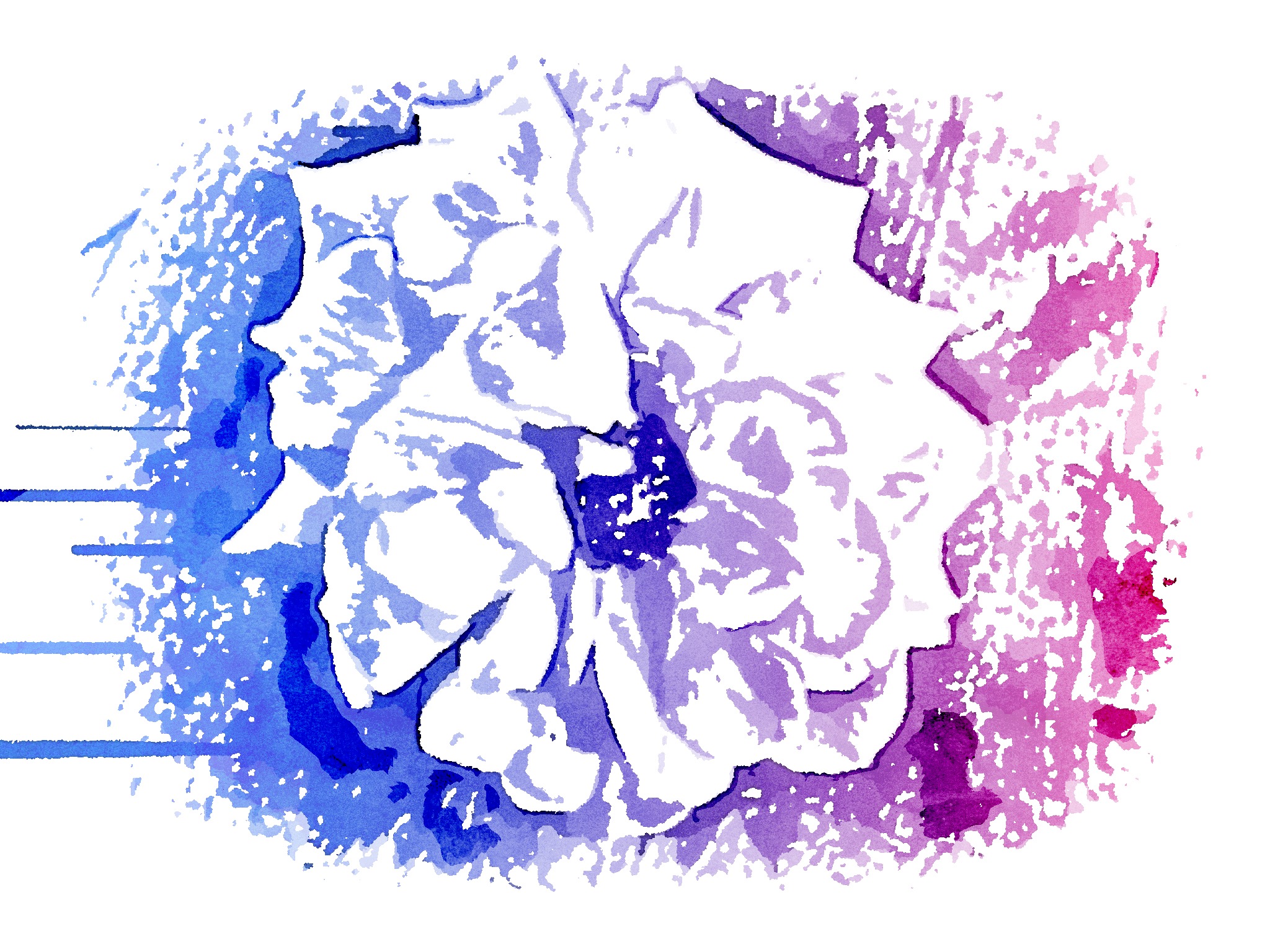
Posterized flower photo done on my desktop


I ordered a table online. Three weeks later, I received a note from the apartment manager that my table had arrived at the front desk. Package deliveries are nothing like deliveries at our former home where a package would arrive and lean against our door. The apartment complex has implemented many security measures: key fobs for entry and elevator use, a room for locked USPS mail and parcel boxes, and a locked room for packages from UPS and other delivery services. In a complex that contains two buildings, one with five stories, the other with 14, one can imagine the number of packages that arrive daily at the front desk.


Brushstroke practice to loosen up


Same painting upside down. Which is more pleasing?


We live in the shorter of the two buildings, a half block away from the front entry. We have to plan for package pickups. We can either take the elevator down to the street level and walk to the front entry or walk down one flight of stairs to the third floor which is connected to the first building by an expansive patio area and then down their elevator. We are still figuring out delivery services. Every day we find a new adventure in just making our way in an apartment building.

Of course, the small metal table needed to be assembled. I became proficient at assembly when we moved to Japan and transported boxes of bookcases, beds, and tables that needed to be constructed on our arrival. But this metal table flummoxed me. The screws connecting the legs only went in halfway. I needed an electric screwdriver to finish the task. Ours is packed securely away in our storage containers along with our paper shredder, pencil sharpener, rain boots, measuring cups, tax files, lightbox, and other items I didn't think we would need while existing in limbo between houses with most of our possessions stored away.

We purchased a new electric screwdriver and with Bill's help, I now have a table. And already I am happy to sit and draw and paint some postcards. I made a set of overlapping words to send to some art students from St. Cloud State University, my dad's alma mater. I began to feel the sense of immersion that comes when something I'm working on is going well. For the cards, I used the words Grow and Change. When Bill saw them, he laughed, "Enough already. I don't need to grow or change for a while." Me too.


Second version of Change/Grow postcard

Third version  Which would you pick of the three?


Read more about Dr. Mihaly Csikszentmihalyi's research into happiness and creative flow:
https://solaramentalhealth.com/flow-and-happiness/

Thursday, November 9, 2023

REEL TIME

The last roses of autumn


Just as the TV showed the French police officers erupting out of their car to end a frantic chase of a right-wing terrorist trying to blow up housing for immigrants, we heard the wail of a siren in the background adding to the tense moment in the movie. We first thought the sound was bringing more officers coming to help on the screen. It took us a few seconds to realize that the alarm wasn't part of the film's plot but instead was coming from outside in our neighborhood. 

We paused the movie, walked out onto our tiny balcony, and stood searching the air for the source of the siren. A man on the street was getting into his car. The lights inside his car turned dark as he closed the door. The alarm kept going. It wasn't his car alarm shrieking.

We couldn't figure out where the shrill sound was coming from until we saw a group of people moving around in the glassed-in lobby of the apartment complex across the way. Then several people exited the building, not running, but ambling down the stairs. They gathered in groups in the small park nearby. In one third-floor apartment, a man came out onto his balcony with his little dog in his arms and sat down in one of his balcony chairs. The alarm kept wailing. He didn't move.

We didn't see any visible smoke. Finally, we walked back inside, picked up the TV clicker, resumed the movie, and watched the police officers frantically shooing people out of their apartments and out of the building before the bomb went off. The panicked dwellers ran downstairs, streamed out of the building just before the noise of the explosion hit them.

The alarm outside across from us stopped. No fire trucks arrived. False alarm.

Reel/real life in a city.


Beauty when we need it

I have stepped out of my usual stories with this week's post. The coincidence of the movie/real-life incident was so extraordinary to me that I had to share it. I thought of the movie and the police officers responding to an emergency and I thought of real people and how often we discount something that is possibly life-threatening and don't move until we are pushed.


New York Times' Monday edition had a spectacular display of photos from the Webb telescope with interesting commentary about each photo:

https://www.nytimes.com/interactive/2023/11/05/magazine/james-webb-space-telescope.html 

Thursday, November 2, 2023

REFRESH OLD TOOLS

Some of my well-used pencils

A pencil. 

My favorite tool to use for drawing or doing crosswords. I have them scattered around the house.

If you learned to write with a pencil, you probably used a yellow Dixon Ticonderoga 2 HB, a soft pencil right in the middle of the pencil hardness scale. This pencil was designed by Joseph Dixon in 1812, though earlier pencils can be found as far back as 1650. In the U.S. the pencil came into its own during the Civil War. Soldiers needed something easier to write with than a quill and ink. They carried knives and could sharpen pencils to a point.*

I am taking a series of classes called the Liberated Line, my favorite design element. Each Saturday focuses on a different element of design. We use shape, form, texture, value, space, and color combined with line. Last Saturday's instructor, Amity Parks, took me back to my beginning drawing practice. We used various hard to soft pencils that we each had on hand. I picked up my favorite Eagle Draughting pencil, which is about 6B, very soft, and no longer made though they can be found through online dealers starting at about $20 a pencil. 

We worked to create a palette to show what we could achieve by varying the pressure we put on a pencil. We worked through the Bs, reaching the Ticonderoga 2HB, and then began to experiment with 2H. The pencil weights go from 9B to 9H. Some brands, such as Blackwing, use their own scaling system. I discovered in my first drawing class what a difference each grade and brand of pencil made in my ability to manipulate the line I drew. I loved the soft quality of the Eagle Draughting pencil. I still do. The series of Hs gave me little room to create dark and light strokes. 


Checking the hardness of a line with each type of pencil
 & creating a value scale for each pencil


We used other pencils, chalk markers, and Conte pastel pencils


During the day, we experimented with various ways of creating a letter, including adding color. 


My favorite exercise was a letter hidden within a value drawing, filling the entire area with a variety of pencil marks. 


Halfway through a pencil drawing using both 2HB and 6B pencils


Finished capital H (can you see it?)


As Paul Klee once said, "A line is a dot that went for a walk."

*

Learn more about the history of the pencil:

https://www.themarginalian.org/2013/06/24/history-of-the-pencil/

Story of the Dixon Ticonderoga yellow pencil:

https://weareticonderoga.com/our-story/ 

Check out Pencil Talk:

https://www.penciltalk.org/2008/04/eagle-draughting-pencil

Tour the Sanford Pencil Factory:

http://www.pencilpages.com/articles/sanford/tour.htm

Friday, October 27, 2023

WORDS COME ROUND AGAIN


It doesn't feel like fall yet in San Francisco.


Davenport. When was the last time you heard someone refer to a couch or sofa as a Davenport? The name originally came from Cheshire, England, and was used by a furniture manufacturing family in New England for their expensive, fancy settees, divans, chaise longues, or chesterfields. Maybe if you came from that area back East, you are more familiar with the word Davenport. Recently I have only heard Davenport as a name for a place or person, not something to lounge on.

I received an email inviting me to the International Calligraphy Conference next summer which will take place in Davenport, Iowa. I was curious why that town in the middle of the country in the middle of summer had been selected. I was curious about the name Davenport too. I remembered hearing it used in my childhood, but rarely since. I discovered the conference was dedicated to the work of Father Edward Catich, a monk from St. Ambrose University, who wrote a book entitled The Origin of the Serif (only a calligrapher would write a book on a small mark which has major significance in letter design. Amazon offers the paperback version of this book for $130 -- a collector's item, for sure.) But I digress from the word Davenport. Last night as we sat down to watch the first episode of the original Miss Marple series on PBS, I smiled when I saw the name of one of the leads, Jack Davenport, an English actor. I also discovered that there are twelve towns in the United States called Davenport. There is a lake in Minnesota and also a mountain peak in New Mexico with the name. The first Davenport to arrive in the U.S. was Lancelot Davenport. Now that's a name to remember. Davenport seems to be everywhere I look.
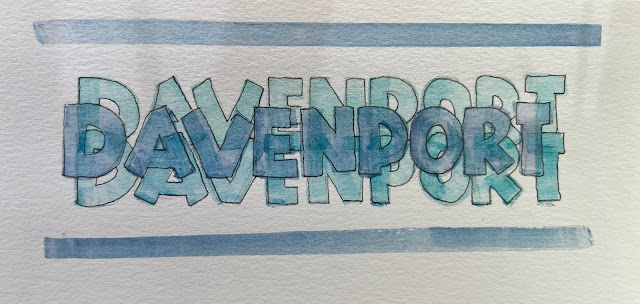

Practicing more layered letters with Neuland font, which is sans-serif


Recently as we drove along Highway 1 which hugs the Pacific Coast, we passed the town of Davenport, which calls itself Whale City. Davenport is only a couple of short blocks long and easy to drive by, but it is a good place to watch whales as they migrate through Monterey Bay. Nearby Shark Fin Beach offers plenty of places to explore, though because of the cliffs towering over the beach, checking tides before walking down the beach paths would be a good idea.

This morning I opened an email from the Commonwealth Club in San Francisco and found that Matthew Davenport, author of The Longest Minute, would be speaking about the 1906 San Francisco earthquake.  Another Davenport!


Letter formed with serifs


I mention these examples of a word that pops up repeatedly for a short time because I also find that true of themes in books that I read. For example, earlier in the year I finished Amor Towles' book, The Lincoln Highway, which takes place during the Great Depression. I also read The Personal Librarian by Marie Benedict and Victoria Christopher Murray, about the Black woman who was the original librarian for the J.P. Morgan Library, and The Book Woman of Troublesome Creek by Kim Michelle Richardson,  both books are based during that time period. The era between the two world wars fascinates me because so many of our ideals and beliefs about America are reflected in the cultural, economic, and political events that occurred from the Great Influenza of 1918 to the beginning of World War II and they continue to echo in the present day. 

I don't intentionally seek out books set in the time period between the two world wars, yet I just finished West With Giraffes by Lynda Reynolds, based on a true story of transporting two giraffes across the country. I picked West With Giraffes because a friend writes essays about rhinos in Africa, which has nothing to do with the subject of West With Giraffes except they are both about African animals and their interactions with human beings.

This theme of personal development during a long trip resonates with me. America the Beautiful? by Blythe Roberson tells about her venture alone into our National Parks and the unsettling history she discovers behind one of the best things about America. The Ride of Her Life by Elizabeth Letts, describes how Annie Wilkins rides a horse across the U.S. to reach the Pacific Coast and what she discovers about mid-century America.

My question here at the end: Why is it that when something is noticed, its appearance multiplies? I just got an email that Tim O'Brien, author of The Things They Carry, is out with a new book called, America Fantastica, and whether it is a good book or not (read the NYTimes review), it follows alongside a fictional character in search of himself by traveling across America.

Check out Davenport, California:

https://www.tripadvisor.com/Tourism-g32282-Davenport_California-Vacations.html

Check out the course offerings at the International Calligraphy Conference:

https://www.calligraphyconference.org

Tim O'Brien's latest book:

https://www.nytimes.com/2023/10/23/books/review/tim-obrien-america-fantastica.html

Interesting online magazine to read:

https://defendernetwork.com/e-editions-2021-live_migrated/  

Thursday, October 19, 2023

MAKING MARKS


A mural in Capitola with some lettering fonts used by graffiti artists

Some weeks I find it hard to sit down and write. World events get in the way. Yet, I also know what value and calmness I receive when I write my thoughts or draw what I see around me. I think about the calligraphy classes I have taken and the meditative quality they create from concentrating on one task. Maybe today is a good day to work with my hands. A moment of solitude.


A part of a piece of graffiti in downtown San Francisco


Last Saturday I took part in a class led by Cora Pearl, who is part of a group of five amazing calligraphers each offering a one-day class this month. Their subject, the line, is my favorite design element. Line is the fundamental element before shape, value, color, texture, or contrast. Without lines we have nothing.


Lines across the front of a building


Humans make marks on everything they touch including caves, buildings, canvas, and the sand beneath our feet. We also now make marks in the sky. Last weekend over our heads the Blue Angels performed aerial stunts that mark the sky and follow a long tradition of aerial acrobatics that began with the early barnstorming pilots during the Roaring Twenties of the last century.


Mosaic of jet trails by Bill Slavin


Since moving to San Francisco, I've noticed how many empty storefronts trail along the streets. They have become a venue for graffiti in quantities that I haven't seen since the beginning of this century. Many people then were outraged by the seeming desecration of public spaces and rightly so, yet some of the graffiti artists, such as Banksy, Dondi White, and Lady Pink, became well-known because of their fantastic flourishes on grey concrete walls. Their work exists in museum exhibits now. Many cities adopted the practice of public murals in response. The murals fill the ugly grey walls, with ideas, lines, colors, and honors to citizens of their communities. In the Bay Area, murals proliferate in Oakland, Santa Cruz, San Jose, and Walnut Creek.


on a San Francisco side street

You may or not like the graffiti put up by taggers or you may or may not like the designs made by architects and designers that appear on the outsides of buildings. For me, one of the values of art is to present new ideas in interesting ways that test your comfort zone. Once I take the time to look and try to understand the other person's feelings, ideas, and process, I can decide whether I like what they produced or not.


Layered lettering produced in Coral Pearl's class by Martha Slavin


Check out the TimeOut article about street artists:

https://www.timeout.com/newyork/art/top-famous-street-artists 

Check out the links to these calligraphers:

http://www.corapearlcalligraphy.com


Friday, October 13, 2023

TWO GODS in the BUILDING


 Bittersweet became our favorite restaurant in our short time in Aptos. The name conjures up all kinds of feelings about this last year. I think of our move and what changes in a neighborhood over time.  People move in and out. Children play, grow, learn to drive and leave. Cars drive into garages, the door closes, and the street returns to the quiet of an adult-filled neighborhood. Bill and I have witnessed and joined the migration from neighborhoods.

 One last evening at Bittersweet, Zeus served us. His first name, an unusual one, given to him by his mother so that he would grow up strong, made me laugh. My family's name is Heimdahl, the guardian of the rainbow bridge into Asgard, the Norse mythical home of the gods. With the two of us in the same room that evening two gods existed in harmony together at Bittersweet.

We still spend a lot of time traveling back and forth to the East Bay. Coming back recently and driving down a street, I realized what I missed about living there: overhanging street trees. We are now living in San Francisco, we are surrounded by concrete buildings, and we look down from our windows on a relatively quiet city street with a children's park across the way and see the tops of the well-trimmed street trees that line the block. Not the same feeling as the enveloping canopy of an avenue of stately, old trees, who could if we could talk in the same language, tell me the stories of what they had protected for the last 50 years.


Watercolors aren't working right now,
but this one I saved by using markers on top.


Our new place in the city is different from either the East Bay or Aptos by the sea, but we lucked out in finding a two-block-long street that runs along the channel that separates the rest of San Francisco from Mission Bay and is a walk from the Giants ballpark and the Warriors Chase Center but also runs near other streets where the trolleys, trains, and buses of a busy city clang along their way. The park across the street is called Children's Park and we can hear the happy chatter of little kids playing among the structures of the park. We've noticed many people walking their dogs (pandemic dogs?), bringing them into restaurants and grocery stores, and reminding us of the well-behaved dogs who would sit quietly in a seat at a Paris cafe.

Instead of a 55+ community, we have landed in just the opposite. Most of our neighbors are 45 and younger. We watch as parents struggle with bags, strollers, and dog leashes and remember those days. We hear conversations about work and coming events at Golden Gate Park. Once in a while, we notice French among the many different languages spoken around us.  

The local grocery store is around the corner and offers organic fruits and vegetables, a butcher's shop, a good deli, and long lines at certain times of the day. Across from the grocer is a wine and cheese shop that serves small plates including various panini with one called Paris, a ham, gruyere, and cornichon pickles concoction on sourdough (the best of San Francisco and Paris). We haven't lived in a city since we lived in Paris and these little shops and our tree-lined street remind me of Rue de Lasteyrie in the 16th Arrondissement.


Our new go-to place is just at the corner. Reveille Cafe offers light fare as well as coffee and tea drinks. We noticed the barista wore a T-shirt with Japanese characters across it. The phrase was in support of Ukraine the barista's homeland. He told us that his dad was Ukrainian and his mother was Israeli. Our mouths dropped open uncertain how to reply.  He talked of family in both places. I thought of Zeus and Heimdahl and wished those mythical figures could intervene in both places.

As we sat down for lunch, we felt lucky  to be in a place that was safe. We are discovering once again that city life is exciting, bustling, noisy, and overwhelming. Bittersweet in many ways.