Friday, September 22, 2023

BACK TO THE ALPHABET


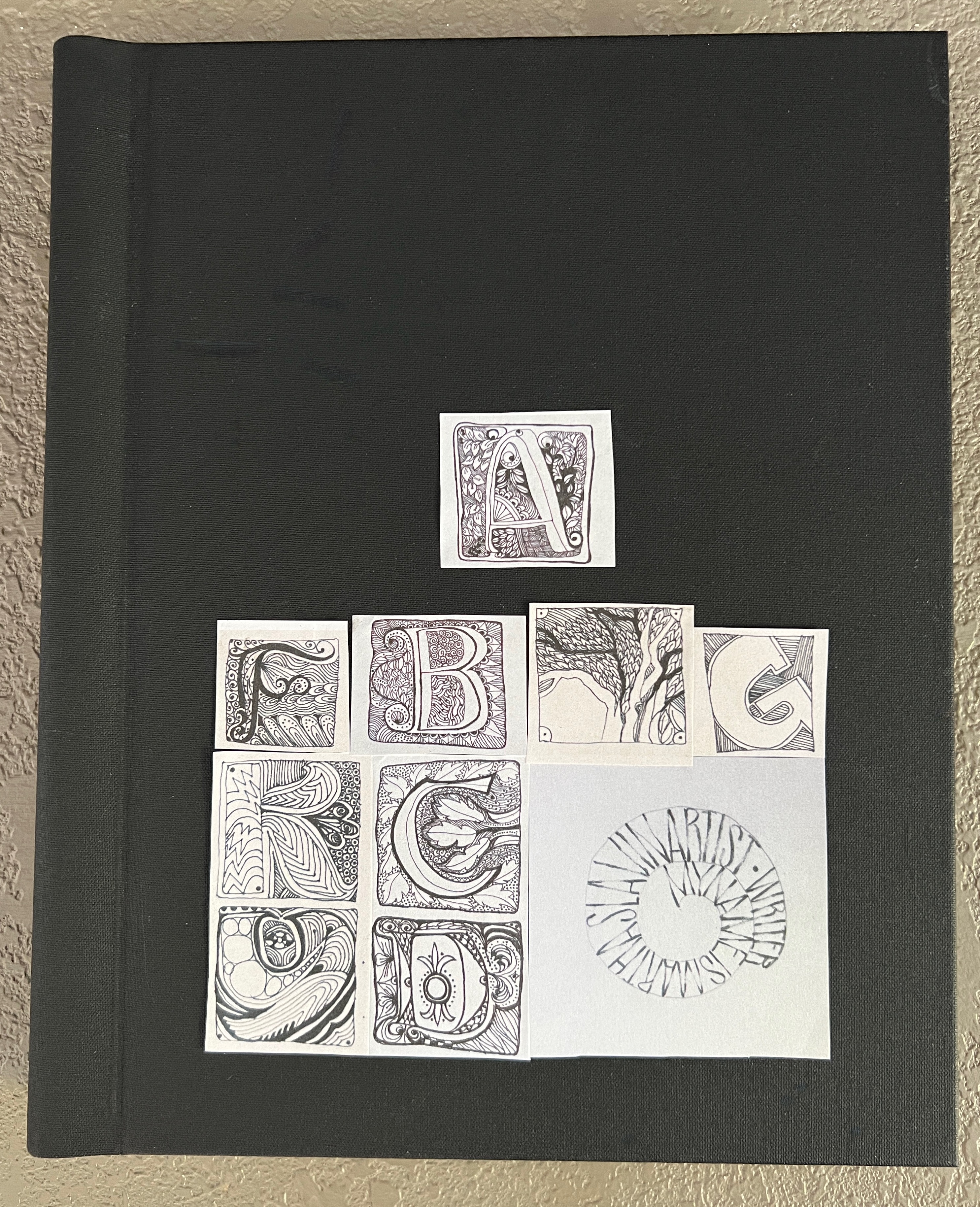
 Creative moments come and go. Sometimes it takes a while for something to coalesce in my mind before I go back to creative work I hadn't finished. Last February I took an art journaling class from Janet Takahashi, but I put the book aside while we prepped our house for sale. Among the art supplies that I remembered to bring with me to our temporary home, I discovered the unfinished art journal that I started in her class. The journal's theme is the alphabet, an abecedarian book with letters and words that start with each letter.

Some of the pages I had filled to the brim in the class, while others just had a penciled letter in the bottom corner to remind me which letter to work on. My first page, the letter A, is easy. A is for Alphabet. Oh, and A is for one of my favorite influencers: Iris Apfel, the 102-year-old New York City fashionista known for her huge black glasses and colorful outfits. I want to be like her at her age.


B stands for Brain (left and right), Brush, Blending, and the Blues. B is a reminder to Begin.


F we need because it represents Form that Follows Function, Fonts, Flowers, and a peek behind a Fold-out.


S covers many drawing techniques: scribbles, stipples, shapes, sizes, spirals, and shadows.


V stands for Violet (think the colors of shadows), Vignette, Viewpoint, Value, and Viewfinder.


An art journal is a place for me to experiment. It's the perfect solution when I have packed away my usual implements and materials thinking that I would be able to unpack them sooner than now. Using different materials and techniques has opened up a new creative space in my head to explore. I had been overwhelmed to try to fill the art journal pages with something new in every space. Now since my supplies are limited, I have gone back to older work which I've copied onto plain paper, and am now filling the pages with these old ideas in new ways. 

L is for Letting Go.


cover of my Abecedarian art journal


Check out Janet Takahashi's workshops:

https://janettakahashi.com/classes-workshops-retreats/

Friday, September 15, 2023

CREATIVE PLACES


By Bill Slavin

My art space has disappeared with our move. The room was a great place to work and filled to the brim with the stuff I thought essential to creating. I also felt more and more cramped in the space, but I never took the time to clean much of the jumble out. With our move, I had the chance. I selected what I thought I could use in our transition and packed the rest away. 


Now that we are in our new temporary home, I’ve unpacked the art equipment that I brought and find myself puzzled by what I left out. I have no drawing tablets, scrap paper, gesso, cutting boards, and other tools. I had to laugh at the decisions/mistakes I’ve made because they have forced me to try new things. 


New place to work


I’m working on our dining room table, which is also filled with our house-hunting papers, computers, shopping lists, glasses, books we’re reading,  and Bill’s cameras. I’m still taking my Zoom watercolor class, but with limited space, I am using a watercolor sketchbook and therefore making much smaller paintings. One lesson Bill and I have learned from our move has been how privileged we were to live in the house we did. We don’t regret moving, but we are re-evaluating our needs and expectations of what we have.


My old workspace looked out on our street and I could see walkers stop to talk or briskly power through their exercise routine. Since our move, I realized that light and view are important. Right now we look out on a small pond and light filters through our windows, which brings light into the house.


by Bill Slavin


Since our move, I have visited other creative friends’ homes and have come away with a little studio envy. Their rooms have supplied me with new ideas for an art space for myself when we have a new permanent house to live in.

 A friend’s studio overlooks the ocean and is filled with her large paintings of the sea. The ocean blues she uses in her paintings wander on objects throughout her house. Another painter friend has a room overlooking the straits leading from San Francisco to Sacramento. She can hear the whistles of the trains on the other side of the water and watch cargo ships wend their way up the straits. Her view includes her colorful garden that spreads across her backyard. Another friend quilts in a pristine space with enough room to hang large quilts on a wall and plenty of storage space for mountains of quilting fabric. A writer/painter friend lives at the top of a hill in the Santa Cruz Mountains with a house filled with family photographs, shells, her pastel paintings, books on writing, and a collection of fountain pens with their smooth flow that inspires her to write by hand.


In each of these homes are treasures, whether a collection of colorful California pottery, a garden brimming with flowers to gather in bouquets, smooth stones picked up on beach walks, or chairs lovingly painted by children. Their homes are like being inside of someone else’s creativity and an inspiration to me to keep around me objects that motivate me in my own work no matter the size of the space I live in.


Friday, September 8, 2023

ABUNDANCE AND SCARCITY


Rio Del Mar by Bill Slavin


One day as I was walking in a neighborhood, I turned a corner to find a schoolyard dotted with hundreds of robins all pecking at the ground, bringing up worms. A feast for an enormous number of birds and a remarkable experience for me. Since then, I've seen the occasional single robin or a couple building a nest, but I've never again seen a field full.

I think of the few times that I have witnessed other large groups of animals or insects together. Just after we bought our first house, we had a plague of mice in our neighborhood. They scurried across lawns, entered the house, and surprised us as they cowered in every room. They disappeared just as quickly from the neighborhood as they came, never to return in such profusion again. 

One summer in Minnesota small frogs filled the grass by the lake's beach. The boys staying in the cabins by the lake collected them in buckets, heaped one frog on top of another, stared at them in fascination as the frogs wiggled around, and then tipped the buckets over to let them go. Sometimes, we think of sizable groups as pests, sometimes they become the victims of our interest and thoughtlessness.


Blue Moon by Bill Slavin

This week within the waters of Monterey Bay, anchovies congregated in huge numbers. We couldn't see them from shore, but as we stood on the sand at Sea Cliff Beach near Santa Cruz, we marveled at the thick line of birds flying above the water. We discovered that the dark brown birds called sooty shearwaters migrate each year from New Zealand. The line of birds stretched back a long way past the marker at Rio Del Mar Beach Trail, a mile away from us. We'd never seen so many birds in one place before. Hundreds of pelicans flew in formation above the sooty shearwaters, who by their numbers created the dark, massive line of birds and with their dives churned up the water to reach the food below the surface.

According to the local paper, the Santa Cruz Sentinel, the anchovies this year are so numerous that the city has had to put special aeration machines into the bay to keep the anchovies alive. Otherwise, their numbers suck up all the oxygen and they would die. We didn't see the anchovies, but we saw the extraordinary number of birds feasting on them. Like the mice in our old neighborhood, both the anchovies and birds will soon be gone for the year. Will they come back again in such numbers or was this a truly extraordinary event?

I marvel, just as we all do, when I glimpse abundance in nature. I think of other parts of the natural world that I will never see: the extinct passenger pigeons, the North African Elephant, or the Atlas lion both extinct by Roman times. People hunted the pigeons for food never realizing that their abundance would end. The North African Elephant became a vehicle in war and entertainment along with the lion in Rome. They all died out because of human interaction with them. We realize how destructive humans can be, but we also have groups working to make a difference in our environment. 

We noticed on our visit to the coastline that the coal-fired plant north of Monterey is being disassembled. The natural gas plant nearby constructed a long pipeline to allow the water that is circulated in the plant to cool down before it is ejected into the bay. Even small actions can have an impact. Bird-friendly coffee growers offer coffee grown using sustainable practices that don't affect the life cycle of migrating birds. Peet's Organic Yosemite Dos Sierras and Birds and Beans Signature coffees are two brands that are certified as bird-friendly.

Sketchbook by Martha Slavin


Read more about the anchovies in Santa Cruz harbor:

https://www.santacruzsentinel.com/2023/09/01/anchovies-invade-santa-cruz-small-craft-harbor/

Read about migrating birds in this New York Times article:

 https://www.nytimes.com/explain/2023/birds-science?searchResultPosition=2#for-migrating-birds-its-the-flight-of-their-lives

Find bird-friendly coffee at the Smithsonian:

https://nationalzoo.si.edu/migratory-birds

More about the Moss Landing Power Plant:

https://www.energy.ca.gov/powerplant/combined-cycle/moss-landing-power-plant

**************

I like to look at other people's drawings. To me, they are more interesting because they show me how the artist's mind works. If you do too, watch this very short video of Jake Weidmann's unbelievable artwork:

https://www.instagram.com/p/CwxYOjHgx4X/ 

Friday, September 1, 2023

HARD SHAPES

Thanks, Bonnie, for the painting Cairns idea!


 Sometimes taking a break from what you are doing helps, sometimes it doesn't. After a couple of months of not painting at all, I was inspired by a gift from a friend. She gave me an apron with a watercolor palette as the pattern, the perfect gift for a painter.


Thanks, Debi, for the apron


I stepped back into painting by picking rocks as my subject. You would think that a nice relatively round shape would be easy to paint. Instead, rocks are hard and often end up looking like potatoes. Once I don't like what I've done, I start trying to correct the painting. I keep thinking that magically, the right color, the right brushstroke will make the painting work. The painting usually ends up all muddy. 


Sketches done with Kuretake paints


After my first try, I took a step backward and painted a palette of the colors from a new box of Kuretake paints, which are Japanese paints that are rich in color and creamy in consistency. 


Then instead of trying to paint an object, I painted quickly and abstractly just to get relaxed and loose.


Three important lessons that I learn over and over again, are that value is more important than color (squint and look at the variety of values in the abstract above), that drawing is really important, and it is easy to overdo watercolors. Keep it simple and fresh.
 

Abstract rocks


These quick studies relaxed me and allowed me to go back and look at rocks with fresh eyes. You will notice even on the smooth rocks in the Stone Cairns sketch that I've created edges with shadows. I had let go of my daily practice and it showed. I plan to focus on rocks and stones for a while.

**************


Friday, August 25, 2023

STORYTELLERS

Pages from my sketch-of-the-day sketchbook for August 2023


Bees tell stories by shaking their tails, directing other bees to pollen sites. Elephants mourn their dead. Dogs communicate with us with facial gestures. We show our emotions by moving our bodies to emphasize our stories. We humans tend to think that we are superior to other animals and insects, and that we have special characteristics that set us apart, but scientists keep proving our assumptions wrong. Instead, we could recognize we are all storytellers, and those stories help to build our communities.

Storytellers in my family regaled us with the adventures and escapades of local farmers, of ancestors who arrived in America by escaping the French Revolution or landing in New York City and walking to Minnesota or driving across the country to live in California. Those stories helped to build for me an image of our family's strengths and weaknesses.


Sitting at a coffee shop in a new town watching all the people around us, I start drawing and making up stories about who the people are and what they are doing. If we were in our old neighborhood, the familiar faces would have told their stories long ago. In new places, I can let my fantasy expand. I noticed the young woman busy at a computer with headphones on, talking continuously as if to herself. The young man with a long beard lifts his son up to his shoulders while his daughter grabs his pants for attention. The couple with hoodies sitting in the drizzle from the high fog, his hoodie grimy with dirt, hers, clean. A young man walks by with his head shaved except for the sumo-wrestler topknot. An old woman hunched over a walker trudged past me. All of these people have real stories to tell, but it is also fun to make up a life about them. Together they could be the source of a new story.


Here is a first sentence to start a story: "The wind ruffled Camille's hair. She looked up and watched as her parents stood, pulled their hoodies tighter, stared at her for a moment, and walked away."

Could this be the beginning of a mystery, a romance, or a multi-generational tale? What would you add next to make this a good story? Show me.


**********

The idea of community has been a recent topic for several columnists and essay writers. Check out David Brooks' essay at The Atlantic, "How America Got Mean" 
and Perry Bacon's point of view in the Washington Post, "I Left the Church and Now Long for a Church for the Nones."
 https://www.washingtonpost.com/opinions/2023/08/21/leaving-christianity-religion-church-community/

Both food for thought of the importance of community and what we lose when we think only of ourselves as individuals.

Friday, August 18, 2023

WE WERE CURIOUS


Did you collect rocks when you were growing up?

I did. My junior high offered a geology course, and I thrived in the class learning about sedimentary, igneous, and metamorphic rocks. I loved the long names of each type of rock, and I loved scouring the ground for good examples. As we packed our house recently, I wondered what to do with the rock collections that I had accumulated over the years including some I kept from childhood. I thought of bringing them back to the beach, hills, or pathways where I found them, but like introducing a foreign species, would I be putting a rock in the wrong place? Like salting a gold mine? I no longer collect rocks, just as I stopped collecting insects in high school and seashells when the beaches became depleted of shells. We've all learned of the damage people do to our environment and I try not to disturb the natural world as much as I can. I take photos instead of what remains.


Walking the Seacliff Beach, we discovered piles of water-washed stones brought up to shore by the waves. Further north is Bean Beach, so named because the sand is covered by bean-sized pebbles, again water-washed smooth. The piles at Seacliff didn't cover the entire beach instead they lay in drifts 20 or 30 feet apart on the sandy shoreline. We wondered why the rocks only washed ashore in separate piles instead of covering the entire beach. When a wave came in and then withdrew, we could hear the clatter of the smaller rocks as they bounced up into the receding wave and came down again. 


Among the smooth rocks were stones with holes where shells protruded after being abandoned by a crab or other sea creature that had made it home. Other rocks were compressed around slivers of shells. How did they form? Were they pieces of tar or cement still malleable enough to capture shells or part of the sedimentary process of thousands of years of compression? Many more stones across the sand were sandstone, fine sedimentary rocks that look like granite but with smaller particles of different colors.


The sand itself was pockmarked with tiny holes created by the wave action as it seeps down through the grains of sand. Small sand crabs and other tiny sea animals hide in the sand too. The seagulls made a dance of poking down into the holes before a new wave would come to shore and the gulls would run from the water. We watched their antics until we turned and walked up the stairs to our car. Our day at the beach concluded.

**************

August 18: a day to celebrate the ratification of the 19th Amendment, which gave women equal rights with the ability to vote. We need to hold on to those rights today.

Friday, August 11, 2023

24/7


A sketch-a-day for August 6


First, a black nose came out from the table, then two sympathetic eyes looked up at us as we sat at a Peet's sipping coffee. We needed a dog hug and the Retriever nestled right up to our legs. People know me as a cat person, but a dog is a good substitute.

After several months of intense action getting our house ready to sell, we landed in Aptos near the beach for a respite. We've been consumed with dual projects of selling and trying to find the right house, talking over all our options, spending time with friends, and working separately on projects in our offices. In our new, smaller space, and with all the activity quiet and no decisions to make, we keep bumping into each other. We sat down to dinner at a local restaurant, and we both gazed off into the distance. For a second, I thought of older couples I've seen who pay no attention to each other. I've wondered if they are sitting in companionable silence or with boredom. Then Bill said, "We'll make this work out well, won't we? We just have to keep laughing!"


Sketch-a-day for August 2


Moving is right up there with death and divorce as one of the most stressful events in our lives. We readily agree, but we are still finding humor in our day, most of the time. Sometimes that takes a little work to achieve. Moving has stretched our energy limits, and reminded us how each of us recovers from energy depletion: Bill needs to be around the hum of other people, I need absolute peace and quiet. Somehow we have managed to navigate life together as people at the opposite extremes of the extrovert/introvert spectrum. A lot of that means letting go, stepping back, and being sensitive to someone else's needs. (Bill still would like to listen to the morning news in the morning. I cringe at the thought of that noise in the morning.) The radio stays silent, but we found a BBQ place in Aptos with good, loud, live entertainment every night.


Sketch-a-day for August 4 and 5


We are making progress. We've recouped some of our lost energy. We have time now to focus on finding a new place. We are enjoying the break from old routines and discovering new places.

Here are a few:

Good Food in Aptos:

Aptos St. BarBQ:

https://aptosstbbq.com

Mentone, a restaurant created by David Kinch of Manresa fame

https://www.mentonerestaurant.com

Persephone Restaurant:

https://www.persephonerestaurant.com

The Hideout:

http://www.thehideoutaptos.com

Good reads:

Francie Low, fellow blogger, has moved too:

https://www.francielow.com/2023/08/04/moving-what-about-the-friends/ 

Carrie Clauson, the wife of one of my favorite cousins, spends several months in Mexico:

https://www.carrieclasson.com/?fbclid=IwAR2OsFFzLvrhp7iLWBUplBGhOWuzLq6yLt_knk2MTDhvvsG9PUJrVeJhFLI