Friday, June 9, 2023

THE OTHER SIDE OF NATURE


Do animals grieve?
We all have seen films of elephant herds mourning one of their members, but I never thought about birds grieving until I stood on our deck and watched a robin couple squawk back and forth after their nest had been raided by a blue jay.
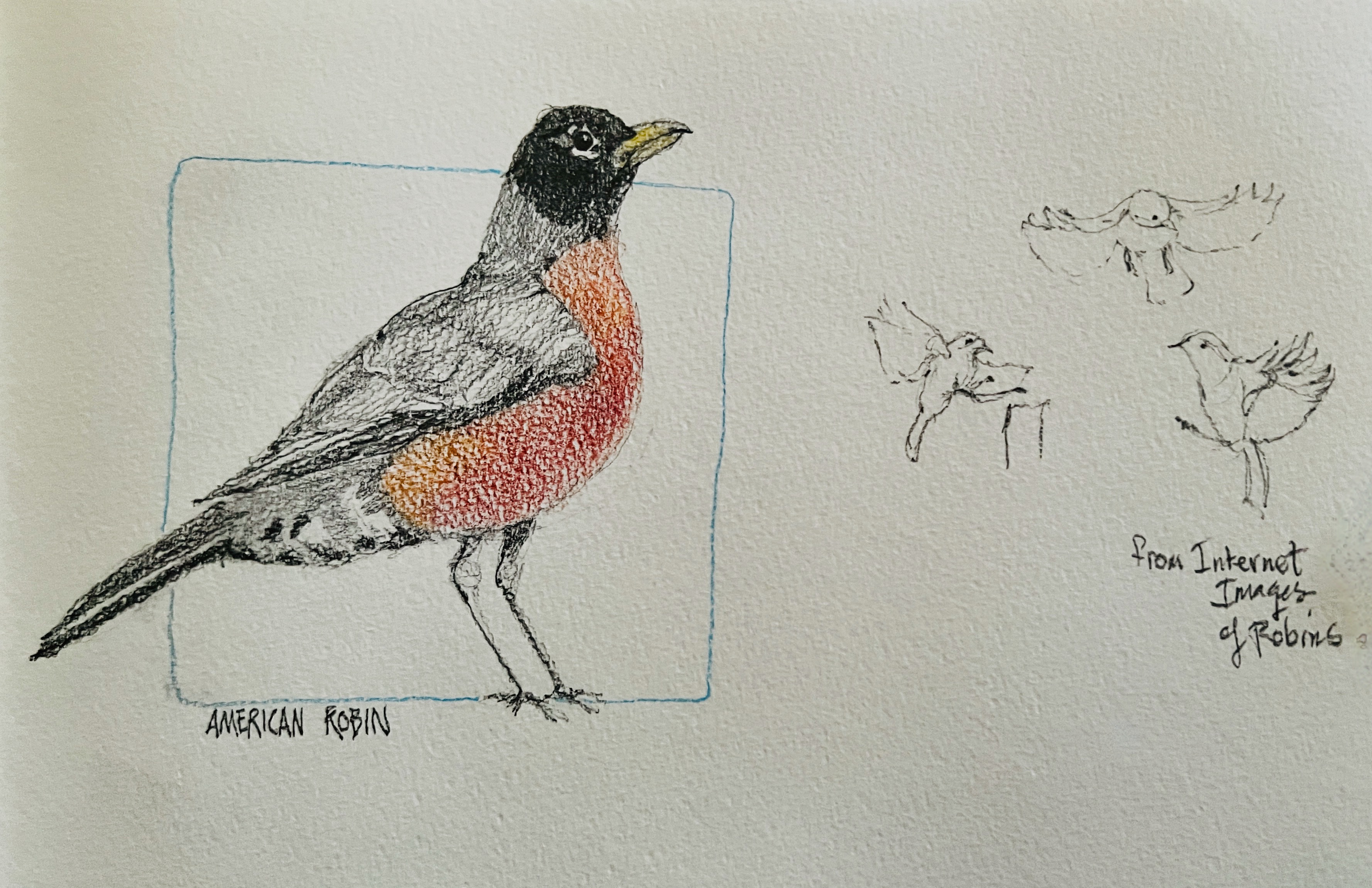


The two robins built a nest right outside our family room door. The male caroled his presence every day in nearby trees. The female brought more and more twigs to the nest and shaped the nest so that it fit her body perfectly. Within a few days, she stayed in the nest most of the time. The male began striking our windows with his claws extended. We put our shades down in the hope that he wouldn't be injured by his attacks on his reflection.

When we came back from our walk one day, we heard the two robins screeching in our front yard. Their calls came from high in the trees and were directed at a Stellar Jay diving into the bushes alongside our house. The jay swooped into the tight space between the hedge and the wood siding. Nearby, two juncos with a nest in the bushes also called out in distress. The robins flew in pursuit of the jay until he hurried away.

The next morning we awoke to more raucous cries. We peeked around the shade and didn't see the female in the nest. We walked outside onto the deck and looked up to see the two robins crying from a tree branch. Two juncos sat near them on other branches. The robins continued to cry over and over for a long time until they eventually flew away. We could see pieces of the nest hanging from the branches. Later in the day, I checked out the nest, spotted four crushed blue eggs, looked down, and spotted a broken robin's egg lying on the ground below the nest. The Stellar Jay had been successful.


Every year we have nesting birds who thrill us when we see the babies attempt their first flight or harass their parents constantly for food. We have also seen losses from blue jays, crows, hawks, and even some birds you wouldn't imagine as nest raiders. We don't know if the robins' calls expressed their grief. What we do know: we had a chance to witness something in the wild that we had never seen before and we were touched by it.


Friday, June 2, 2023

GARDEN EVEN IN THE HEAT


Studying flowers in the garden gives me a moment of calm, a time to take a deep breath, and be in the moment feeling the air around me, picking up the scent of orange blossoms near me, and closing my eyes to the sun.


Roses bloom in the garden with exuberance right now, even when excessive heat curls the tips and tinges the edges brown. I watch the roses change in a short time from first buds to gloriously open to losing their luster, decadent, and faded. The drooping petals, as they slump towards decay, remind me of women from the Victorian era in their voluminous, but tired velvet gowns. 


Roses with color variations on their petals make perfect painting material. I can push colors to the edge of each petal and brush in another to mix in with the first color. Sometimes, if I add too much color, I can let the paint dry then pull out some of the deeper color with a damp brush and mingle another color with it.


I could have blended the edges a bit more on the flower on the left to eliminate the line between the pink and yellow on the petals. Luckily, I can still go back to this painting and fix that. Watercolor is easier to manipulate than most people think.


The edges on this rose look much better. I managed to paint a more subtle gradation from pink to yellow. 

A walk around the garden gives me time to recharge, refresh, look around me, and find something challenging to paint.


Friday, May 26, 2023

COUNTING HUMAN CONTACTS


Fawn by Bill Slavin

Each year in the Fall, I receive an email suggesting that I participate in the annual Cornell bird count. I am always puzzled by the request, not because I'm not interested, but because I don't know how I could count the birds near me. How do I know I am not counting the same one over and over? We have a bird feeder that attracts a menagerie of birds including tiny goldfinches that swarm the feeder in the early Spring, juncos who nest in our bird houses, large ring-necked doves who make us laugh as they try to all sit at the feeder, and blue jays with their raucous cries. There are crows overhead and the occasional hawk. How do I count these without duplication?

We have a fountain in our backyard that attracts birds but is also populated by goldfish. Originally, we placed thirty tiny fish in the large bowl of the fountain. I try to count them as they rise to feed on the fish food we scatter over the surface. Because they are feeding, they don't move much. I can section off the water in my mind to include 4 to 5 fish in one small area and then move on to the next. I have counted as many as 27, but now my most recent count is down to 17. Most of the fish are identical, bright orange, and have grown to be about eight inches long. I spot one lone orange and white easily, as well as two smaller ones. I have to be quick in my count because within seconds the fish are done feeding and swim back down close to the bottom of the pool.

I have participated in bee counting after hearing that bee populations are in decline. Since they are smaller and hover in place they are easier than counting fish or birds. The instructions asked me to observe a particular plant for a certain amount of time and record the number and kinds of pollinators that use the plant. In the Spring we get a good collection even without counting the seemingly hundreds that buzz at the tops of the Japanese maples in our yard. Driving inland towards the California farmlands, I was heartened by a line of flowering trees filled with bees. Thousands of bees.


Two by Bill Slavin

Viewing such numbers of other species, I understand what a small part I play in the natural world and how much we humans have damaged the habitats of other living things. A couple of years ago thousands of migratory birds died in New Mexico. A freak phenomenon. Scientists suggested that an early cold front, drought, smoke from Western fires, lack of insects, and too early migration caused the deaths. This year at least two gray whales have washed up on Bay Area shores near San Francisco. Their deaths have been attributed to starvation or boat collisions from looking for food in busy shipping lanes. Just one more sign that climate change is wreaking havoc on all of us, big and small. 

A friend studies elephants depicted in artwork through the ages. I was shocked when she wrote that one breed of elephants became extinct as early in human history as the reign of Alexander the Great (356 to 323 BCE) whose army rode elephants in his wars across the European-Asian continents. We know of their existence because they are represented in artwork of that time. How many animals and plants have disappeared without our noticing?

That is my good reason to sit in our backyard beside a flowering plant and count bees. One small thing.


Friday, May 19, 2023

IT'S THE SMALL THINGS


Celebrating Children's Day in Japan on May 5


Long-time habits seem like minor things in life. The other day I used a different cereal bowl than my usual wide, low one. As I was scraping the steep sides clean, I noticed how different The new bowl felt. I had to work harder or differently to do the same task. Small thing to think about, but it reminded me of the little changes that occurred when we moved to Tokyo.

First change: I bought envelopes to mail letters at the stationery store next to our apartment building. I inserted my letter and licked the envelope only to realize more than once that there was no glue along the edge as there is in the United States. The Japanese used two-sided tape to seal envelopes - a much more sanitary closing when you think about it. They also address horizontal envelopes in line with their culture and opposite of what we do. Traditionally, the address moves from large to small, first the postal code, then  Japan followed by the city, the district, the nearest street corner, and the house number, which is not in numerical order, but in the order when the building was constructed. At the end is the person's name, last name first. Whenever I mailed an envelope, I thought of the difference in a culture's values. Is the individual more important or is the community?


Prayers hung at shrines in hopes of success on school finals

The second change:  I walked around our new neighborhood and saw at each street corner small plastic bags filled with trash and covered by a blue net haphazardly piled up across the sidewalks. At home in Danville, we had four large containers to collect our own trash, compost, and recyclables for the week. In Tokyo, I questioned their practice because the local crows quickly figured out ways under the blue netting and tumbled the trash out on the walkways. It just seemed like a huge mess. I later found out that Japanese homes reused much of what we Americans consider waste and each household left only a small grocery bag filled with absolute waste from a week of careful planning. After our first week in our apartment, I put our normal trash in the complex's small containers in the community closet meant for the 14th-floor occupants. Our trash alone filled the containers. I had to rethink our practices.

Third change: Walking down the street, we learned to walk single file because of the crowds on the walkways and also to walk on the left side of the path. The Japanese drive on the opposite side of the road from us and walk the same way. We also noticed the police kiosk in every neighborhood. I thought how easy it would be to summon help when we needed it.


Children Walking to School in Japan


We marveled at the line of neatly dressed kindergartners walking with their teachers down the busy streets. We saw same-aged children traveling by themselves on subways to school and the people on the trains looking out for them. Each child carried a heavy rigid backpack covered in patent leather or shiny plastic. They also wore either a red or yellow cap to make them stand out in a crowd.

Living in a different culture helped me to dissolve old habits and small-minded thinking that my own way was the only way to do things. The little differences made me more aware of alternative ways of living and how set in our ways we become when we don't experience the ways of other places.

Japanese builders put windows to frame a beautiful view


Friday, May 12, 2023

BLUE SKIES AND WIDE OPEN PRAIRIE

Sculpture in Colorado Springs

A friend from Minnesota moved to Washington State only to move back to Minnesota because she couldn't adapt to the scenery she found in Washington. Boundaries created by tall trees, towering mountains, hills, narrow streets with tall buildings, and the ocean left her longing for the wide-open prairie. I didn't quite understand her feelings until we spent several days in Colorado. I had the reverse sense of space. I couldn't find the boundaries that I'm used to in California: hills, mountains, ocean, streets lined with trees or buildings. Instead, the intense blue skies and wide, flat plains kept me from feeling any boundaries. My senses tried to reach too far. I was glad when we reached Manitou Springs, which is within the Rocky Mountain range. I had edges and boundaries again, and my line of sight narrowed.


Mural in a coffee shop

I drove from Denver to Colorado Springs and remembered how much I love to drive long distances on straight, not-too-busy roads, a leftover from childhood when my family took car trips back to Minnesota. My dad would drive at night through the deserts and stop at motels where my mother would test for cleanliness, while we waited to swim in the pool. At restaurants, my requests for hamburgers would never vary though I had to adapt to other states' versions or order a California hamburger with lettuce and tomato.


Walking Pikes Peak mural

I was often the instigator of a call to stop at every little building that claimed to be a museum housing artifacts and dinosaur bones from the local environs. My parents learned to look for museum signs and to turn the car at a corner in hopes that I hadn't noticed. Not much luck there. We wandered through the Jim Bridger Museum, the Little Bighorn Memorial also known as the Battle of the Greasy Grass, Zion National Park, the Grand Canyon, and Salt Lake City. We walked by the falls in Twin Falls, Idaho, drove through the Black Hills to see Mt. Rushmore, roamed Bemidji, home of Paul Bunyan, and stood next to the source of the Mississippi River. As we drove closer to Minnesota, the land became flatter and fields of corn, wheat, and soybeans stretched towards the horizon. I would get dizzy from watching the straight rows of corn stalks flickering by our windows for mile after mile.


Cat and Bananas mural


Last weekend in Colorado Springs, Bill and I discovered that the city has opened itself to artwork all around the downtown. Each corner has a bronze sculpture. We were delighted to see the murals covering the sides of so many buildings. And we found a museum. We stopped at the U.S. Olympic and Paralympic Museum where we saw the Wall of Wheaties and the interactive exhibits that test your speed, aim, and balance. I tried a race with Olympic champion Carmelita Jeter who took 3.21 seconds to finish our race. I hadn't even moved when she crossed the finish line. I took 15.2 seconds. So much for my racing career. The movie at the end of the walk through the museum shows highlights about Olympians. I teared up watching the film. Walking out of the museum, I looked up at the deep blue sky and understood why so many people are moving to Colorado Springs.


Cherry blossoms on a manhole cover. Cherry trees were blooming.
You can see a few cherry blossom petals around the cover.

This long weekend trip was just like old road trip times. I had a chance to drive long roads again and visit a quirky museum that reminded me of our country's history.


Check out the US Olympic & Paralympic Museum:

https://usopm.org

Check out my race with Carmelita Jeter:

https://digital-locker.usopm.org/oOYpIcxbNCJugFcY/training/speed

We stayed at the Antlers Hotel in Colorado Springs. We recommend it. We had a view of Pikes Peak from our window:

https://www.wyndhamhotels.com/wyndham/colorado-springs-colorado/the-antlers-a-wyndham-hotel/photo-gallery

These two sites have good info about road trips:

https://www.roadsideamerica.com

https://viatravelers.com/minnesota-to-california-road-trip/ 


Friday, May 5, 2023

I'D RATHER WRITE OR PAINT

Watercolor sketch of the Italian countryside

When we cleaned out our attic last week, I rediscovered my art portfolios from long ago including an unopened package from my parents that to my disbelief contained examples of my school years work from kindergarten to college that my dad had saved. Like father, like daughter. I had to laugh at this generational inclination to record our histories. I had done the same thing for our son. 


Early drawing of trees

These old drawings intrigued me because I noticed a stream of subjects that held my interest from one year to the next. I drew dozens of trees, many women in fashionable outfits, and figures from weddings. In high school and college, I filled large newsprint pads with drawings of models in every position imaginable. I created a zillion graphic designs as well.

Tree Studies in 2021


I have been amazed at the quantity of work, which as I leafed through the stacks of paper, helped me to see my progression from awkwardness to confidence as an artist. If only we all had such similar detailed information to look back on for signs of our growth in other areas of our life, we could say to ourselves, "Good enough."


Leaf studies


I thought of my mantra: "practice, practice, practice," and realized I had done just that. Now my question is: what do I keep?


Friday, April 28, 2023

I'D RATHER BE READING

During my walk, I looked at the sky and saw one small cloud begin to grow


Ideas Floating in the Air:

Catcher in the Rye, Grapes of Wrath, Diary of Anne Frank, 

The Bluest Eye, The Kite Runner, or To Kill a Mockingbird. 

Have you read any of these books? All of these books are often included in high school curriculums and are some of the most challenged and banned books in America.

These books appear on the American Library Association of the previous decade's 100 Most Banned Books. If you think like me that these books ask challenging questions of the reader and are ripe for discussion of ideas, then you have to wonder why these "dangerous" books would be high on that list. In the new documentary about author Judy Blume, one teenager in the 1980s came to a mic during a school forum to say that her parents had the right to censor what she read, but no other parent should be allowed to do so. Sound familiar. We once again live in a heightened time of book banning and even book burning. The Harry Porter series has been burned in several parts of the country.


A minute later, one becomes five

My parents allowed me into the adult book section of the library in fourth grade where I picked out textbook materials about the Native Americans whose lives and history fascinated me. I also chose novels that looked interesting. They censored very few of my chosen books. They surprised me when they removed from my stack An American Tragedy by Theodore Dreiser, who became a Communist later in life. Their decision wasn't based on how well-written the novel was, instead they succumbed to the fears of Communism that were prevalent at the time. An American Tragedy is still considered one of the great American novels, no matter what political leanings the author had, and a good murder mystery, to this day one of my favorite genres. And, of course, I read the book as soon as I was away from my parents.


Within five minutes the same cloud grew larger in the sky

Honor National Book Week, April 23 to 29, by reading a book, preferably one of the banned books of this year:

The Bluest Eye, Gender Queer, Out of Darkness, or Lawn Boy


If you care about books being banned, and women's equal rights in each state, watch Amazon Prime's new documentary about Judy Blume whose books are often in the top ten of banned books.

An article in the 19th News about the top 13 most banned books in 2022:

https://19thnews.org/2023/04/banned-books-list-2022-american-library-association/?utm_source=The+19th&utm_campaign=8414aa3565-19th-newsletters-daily-0424&utm_medium=email&utm_term=0_a35c3279be-8414aa3565-368626060

Suggestions of good reads:

Price of Eggs, an essay by Crys Wood, :

https://americansofconscience.com/price-of-eggs-crys-wood/

Check out her blog too: https://thisiscryswood.com

Chandra Lynn has a new book of poetry, Musings from My Younger Self:

https://www.amazon.com/Musings-Younger-Self-Chandra-Tyler-ebook/dp/B0C2NN7ZY6/ref=sr_1_1?crid=36KLI03HJ5DT2&keywords=Musings+from+my+younger+self&qid=1682080115&sprefix=musings+from+my+younger+self%2Caps%2C101&sr=8-1

and check out her thoughtful blog:

https://iamchandralynn.com/2023/04/01/reclaiming-april-me-too/