Friday, July 16, 2021

HUMBLE PIE


One of life's simple pleasures, getting together with people with similar interests, causes me to search for art and writing classes. I've never stopped being a student. I like the inspiration I collect from other people as they work on art or writing. Like the old quilting bees from long ago, the communal nature of these gatherings satisfies a need in me. I have friends who find that same space by playing cards or Mahjong, making crafts, or learning how to make a better pie crust. We humans thrive in community.

 My favorite mantra for working in art, "It's just practice," helped me through classes at the annual calligraphy conference I attended by Zoom. Though I was eager to begin, the old familiar feelings of failure, of being not quite good enough cropped up. But I pushed them back with "It's just practice." 

The first class I picked concentrated on values, with exercises going from dark to light and back again. Same kind of exercises I've been doing since college with a graphite pencil. The result becomes a scale that shows the multitude of greys possible. I thought when I signed up, this class was for me. I love working with pencil and grey scales. I read the list of supplies and realized that there was more to the class than the pencil I had in my hand. We were to do the same thing with gouache, a medium I rarely used.


Watercolor mixes on the page


I've done a hundred watercolor color palettes. They are fun to do as you can see the mixing of color right on the page. I'm pretty good at getting a variety in the mixtures. But gouache is different. Gouache is an opaque watercolor, thick and creamy like acrylics, which has usurped gouache's place in most painters' toolboxes. Many calligraphers still use gouache, though, in their broad-edged pens to add color to their lettering. I've never tried it since I have trouble doing calligraphy with just the usual ink. But here I was, sitting in a class with calligraphers, much better than me, holding four brushes clasped in my fingers to mix a gradual set of darks to lights. I found it hard to either darken or lighten the colors so that I achieved the slight gradations I could find with a pencil. I repeated painting each variation on four different colored papers. Each color of paper changed the relationship of the gradations -- a two-for-one exercise. The darkest paint at the bottom disappeared on the darker paper. The mid-tones did the same on the middle-value paper.


Another humbling experience came from my second class. Watching the instructor was like watching magic. She moved her pen across the page with ease. She played with each letter. Swoop and a beautiful line resulted. Her mantra, "Relax your fingers, relax your shoulders, relax your whole body, breathe," set us in a quiet place to concentrate but also to let go of all that tightness we can develop as we try to be perfect. 

"I can tell when you are trying to work the pen and not go with it," she said. I listened and attempted to relax into the stroke just as I could with a pencil or with a brush when I wasn't trying to draw letters. Those old familiar feelings crept in. When we took a break, I walked away feeling frustrated. When I got back to my practice sheet, I thought, "Not too bad for a first practice. It's okay. It's just practice."


When I finished the week, I had a good collection of various techniques. I had a chance to see what other people were making. I realized I'd gotten better with a broad-edged pen (Practice, practice, practice: another good mantra). I discovered in my last class, which was the design of one letter inside a geometric shape, that I wanted to continue with that concept and make another A to Z book with each letter representing a flower.


Take a look at the mini-classes in calligraphy that are available from the Legacies III International Calligraphy Conference. You can purchase them even though you were not an attendee. These classes are a great way to try calligraphy from some of the masters.

https://www.calligraphyconference.org

Or check out these instructors whose classes I took at the conference:

Janet Takahashi: https://janettakahashi.com

Annie Cicale: https://www.cicaleletteringdesign.com

Carrie Imai:  https://carriedesigns.com

Judy Detrick: http://www.judydetrick.com

Friday, July 9, 2021

GOOD SUMMER READS 2021


What better way to liven your summer than with a good book (audio, Kindle, or real book, whichever works for you). While I am Zooming calligraphy classes at Legacies III, the 39th International Calligraphy Conference this time sponsored by the Texas Lettering Arts Council this week, I am also accumulating suggestions for good books to read this summer.

Here are my suggestions to keep you fascinated, thrilled, thoughtful, and full of good humor:

First, Roger Bennett's book, Re(born) in the USA, will fill you with hope. He is originally from Liverpool, England, loved America since he was a kid, and overstayed his student visa. Now a U.S. citizen, he has written a book about what he loves about America.

Then there are a few more:


Several people, including me, recommend:

The Library Book by Susan Orleans

This Tender Land and Ordinary Grace, both by William Kent Krueger

Stay by Catherine Ryan Hyde

The BookWoman of Troublesome Creek by Kim Michele Richardson

The Henna Artist by Ala Joshi

The Ragged Edge of Night by Olivia Hawker

Finding the Mother Tree by Suzanne Simard

Last Best Hope: America in Crisis & Renewal by George Packer

These will get you started on a long, pleasurable summer of reading.  Check for more captivating recommendations on my Book Lists Page. Continue to support your local book store with your purchases. Happy Summer Reading!

Theodore Parker: "The books which help you the most are the books the ones which make you think the most." 


Friday, July 2, 2021

A TOAST TO SMALL PLEASURES


We sat with good friends over dinner and laughed at words that conjured up memories in us all: summer camps, paper routes, running with friends from the neighborhood, building forts in an empty lot, dressing up in costumes, the buttery taste of Ritz crackers, cooling off in a plastic wading pool in the backyard, and watching a Fourth of July parade with bands of tricycles and lawnmowers. 

Sweet memories of slower days of summer unmindful of any controversies around us. 

More images popped up: rolling down grassy slopes,  feeling the tiny fish nibble at ankles while swimming in a lake, searching for four-leaf clovers in the grass, scraping the cream off the top of the milk in a milk bottle, and the jingle of an ice cream truck. 

Simple pleasures.

According to recent research, these types of memories help us build emotional resilience to current events. Psychologists say that if we can find the positive moments from our daily lives, we can turn our languishing feelings around. Maybe that is why the four of us found that reminiscing about childhood adventures allowed us to open up to laughter again.


Remember to thank an essential worker. We wouldn't be here without them.


Perry Bacon from the Washington Post said it best in his salute to the all-stars of the pandemic. We need to remember the efforts of these people who worked to keep us alive.

by Perry Bacon:

https://www.washingtonpost.com/opinions/2021/06/24/pandemic-all-stars/?utm_campaign=wp_week_in_ideas&utm_medium=email&utm_source=newsletter&wpisrc=nl_ideas 

Read Adam Grant's article in the New York Times about mental health after COVID:

https://www.nytimes.com/2021/04/19/well/mind/covid-mental-health-languishing.html?smid=url-share


Photographer Mary Ellen Mark captures girlhood in the exhibit at the National Museum of Women Artists. The exhibit is available online: 

https://nmwa.org/whats-on/exhibitions/online/mary-ellen-mark-girlhood/

I joined Earth Day and YES! Magazine in pledging to keep July plastic-free. Hard to do, I know, but every little bit helps.

https://www.earthday.org/campaign/end-plastic-pollution/


Friday, June 25, 2021

WHAT DO YOU SEE?

 What do you see when you look closely at something?


In elementary school, I became nearsighted, so nearsighted that my world without glasses looked like an Impressionist painting -- all blurred edges and strong contrasts. With glasses, the world came back into focus.


I spent hours drawing. I didn't know about the 10,000 hours of practice that Malcolm Gladwell espoused to become an expert at something. I just liked to draw. I made page after page of fashion designs, drew faces, and used the examples in the Walter Foster series of how-to-draw books to help me understand what was underneath the outside layer of what I was drawing.


My knowledge of the human face has become intrinsic. With other objects, I still need to observe closely their structure to draw them.


When I was a teaching intern, one of my students refused to draw anything but horses, which were a major part of her life. She was good at drawing them because she rode them, understood how they moved, and could draw the horses from many different angles.


Though I've studied perspective, my drawings of buildings can still be wonky. I have watched architects in a watercolor class draw preliminary drawings of buildings before they put paint to paper. Their understanding of the inside structure and perspective shows in the paintings that result. 


Backside of an old building in SF by Martha Slavin

My parents kept several books of anatomy, tucked in drawers because of the nude photographs. Not too hidden so they could be found easily, and not really forbidden to be perused. One of the books was a pop-up book that showed the different systems inside the human body. I loved unfolding each layer to see the muscles, then the blood vessels, and finally the bones. In another book, I found photographs of the human body at different stages of life. The photos showed the changes in head size and body shape from infancy to old age. I still remember looking at the changes to the ear as a person advances in age.


Doodles of an older and younger woman. How large the older woman's ears are!

At a museum, I would rather spend time in a room full of artists' drawings than in a room with finished paintings or sculptures. The drawings give me a window into the workings of that artist's mind. My favorite sculptures are Michaelangelo's unfinished one where the bodies seem to grow out of the stone.


courtesy of
Academia Gallery/Wikipedia


All those early exercises developed my interest in layers. What lays below the surface of anything? A good question to ask about everything we do. First, how about asking that question about where you live?


Friday, June 18, 2021

STEPPING OUT

Can you define American culture? 

Not an easy question to answer. 
People who live out of the country 
often suggest that America represents equality and opportunity.

Those of us who have lived in the mainstream have a chance this summer to take in a wealth of America that we have missed. We can travel first of all, but we can read books, go to exhibits, and attend music and art festivals to immerse ourselves and become more aware of all the cultures that make up America, and we can volunteer with numerous organizations to strengthen bonds between groups. We have the chance to grow into a more inclusive country.

We can learn more about American history that includes events such as the Tulsa Massacre that for most of us were missing from our history books. We know that many of us come from immigrant families. We take pride in that idea. When you listen to the other voices in America, you begin to understand what you have missed: wisdom from a different way of life, hardship brought about by prejudice, gerrymandering, and incarceration, and a common appreciation of American ideals. We have the chance to step up to inclusiveness and fairness. What better time than now?

The Smithsonian American Art Museum offers an exhibit called "The Rise and Impact of Chicano Graphics."
portrait of Dolores Huerta, activist
by Babara Carrasco
at the Smithsonian American Art Museum


The Minneapolis Institute of Art has an exhibit of Leslie Barlow's work, "Within, Between, and Beyond," about mixed-raced Americans.

Kelly Shay & her 2 Daughters
by Leslie Barlow
at the Minneapolis Institute of Art

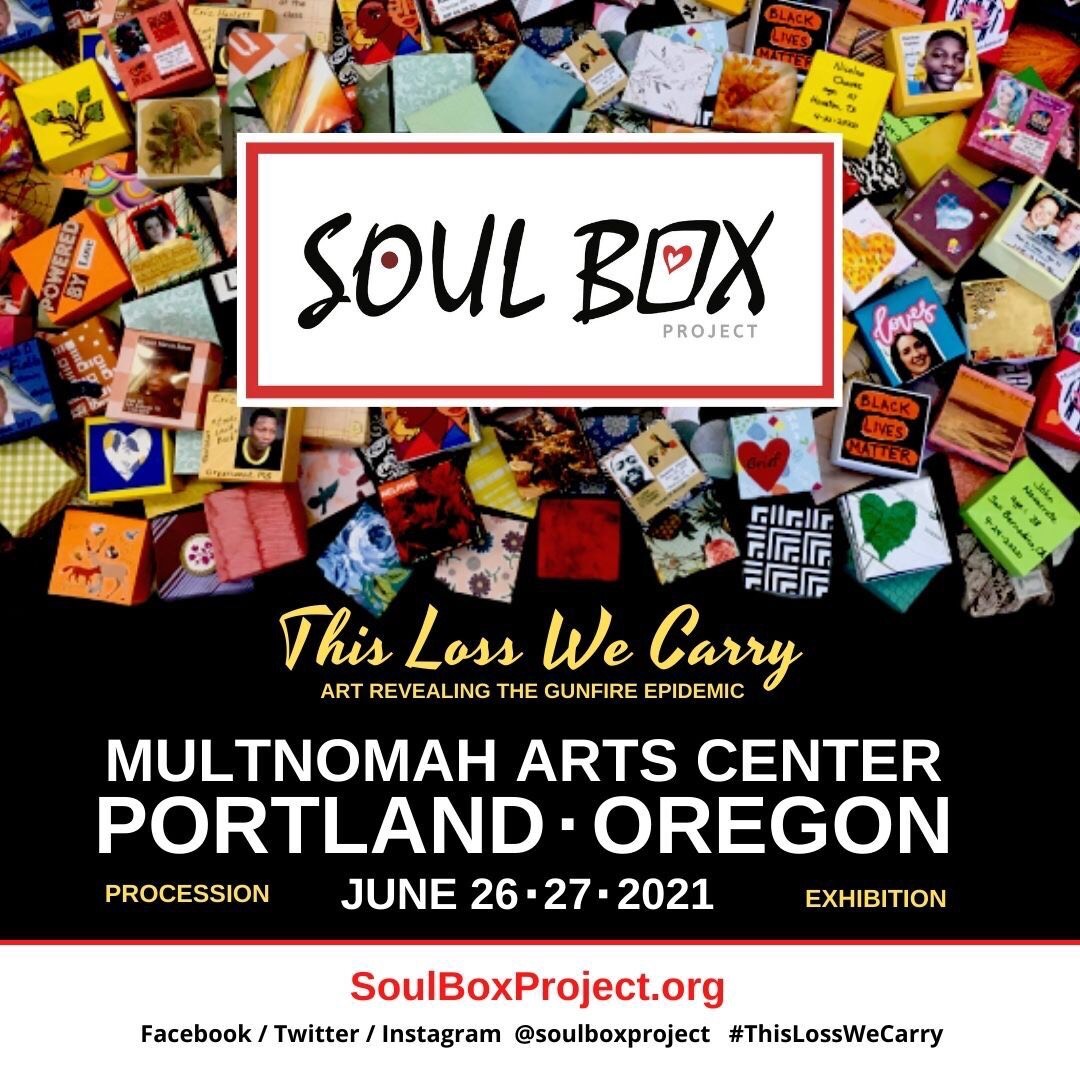
The Soul Box Project in Portland, Oregon, whose volunteers have made over 180,000 boxes to commemorate the lives lost to gun violence, will exhibit 70,000 of the boxes at the Multnomah Arts Center. This is a pre-exhibit before the collection of boxes will be taken to Washington, D.C., for display at the National Mall on October 16-17, 2021. They are hoping to have 200,000 made by then and could use more volunteers.


Don't miss the Art and Soul Festival in Oakland, CA in July (dates will depend on continued good news about the pandemic receding).

Good books to read this summer:


Check out these exhibits at museums around the country:

Take a walk through the Legacy Museum and Memorial in Birmingham, Alabama

https://museumandmemorial.eji.org

"The Rise and Impact of Chicano Graphics" at the Smithsonian American Art Museum:

https://americanart.si.edu/exhibitions/chicano-graphics 

We missed this exhibit of Native American artwork at the Minneapolis Institute of Art (MIA), but you can see parts of it online or purchase the exhibit's booklet: Hearts of Our People

https://new.artsmia.org/hearts-of-our-people-native-women-artists/

Don't miss "In the Presence of our Ancestors: Southern Perspectives in African American Art"  and Leslie Barlow's exhibit about mixed-race people, "Within, Between, and Beyond" at MIA

Or go to the Chicago Institute of Art: "Bisa Butler: Portraits" quilts that are eye-popping.

https://www.artic.edu/exhibitions/9324/bisa-butler-portraits

Join with other volunteers to make Soul Boxes:

https://soulboxproject.org/home

Check the website for news about the 2021 Art & Soul Festival. The 2019 guide is on the website and gives a good overview of what to expect at the festival:

https://www.artandsouloakland.com

Friday, June 11, 2021

WAITING FOR HOPE


 I expect you all have a COVID story.  Bill and I have been touched by COVID as friends, a relative, and a colleague all survived this serious illness and the long-term after-effects. We know we have been lucky in comparison to the many stories of families decimated by the disease. This past year has been a raw year full of tragedy, of confronting and recognizing our past history, of finding new ways to communicate with each other, and experiencing deep personal losses and triumphs too.


We've spent more than a year sequestered, teaching and taking classes and talking with friends on Zoom. We were fortunate not to be full-time employees having to home school/Zoom class with children, we have a secure place to live, our son has brought us groceries each week, and we developed a new appreciation of a quieter life. For now, we hesitate to get back into the full swing of things. Our driving skills need to be updated and we don't want to fill our calendars with too many things that we love to do but leave us little time to sit together outside, talk with each other, and just read the paper. At the same time, we understand the sense of relief and joy that most of us are feeling with the loosening of restrictions.


We can't help remembering the last eighteen months and the almost 600,000 Americans who lost their lives to COVID -- thousands who could have escaped COVID if the previous president had not downplayed the disease and encouraged politicization of public health and public responsibility. We are glad that the vaccines are working to bring down the numbers. We are getting to a place where we don't feel the vivid anger we once did about people who put their own needs above others. We have been pleased to see the majority of people still wearing masks even outside and being considerate of others. 


We think of getting together with larger groups of friends, but the thought of the thousands of COVID victims squashes that desire to just return to normal without somehow acknowledging what we have been through in the last 18 months. Perhaps, next year on Earth Day, Arbor Day, or Memorial Day, we could re-imagine the significance of these holidays and plant trees in honor of each person lost to this disease. We could remember not only the people but the clear skies that resulted from the whole world sequestering and slowing down. We hope by then that COVID can't find any more victims.


As I sat in Zoom meetings, I took out my sketchbook and used the opportunity to draw the people I saw on the screen. I didn't try for likenesses, but just the quick facial gestures that express personality. Sometimes, I caught faces in their worst moment with exaggerated wrinkles, grimaces, or squints. If you recognize yourself or someone else, assume it is not the person you think it might be. They are only gesture drawings, not portraits, just practice, not an attempt to portray a real person. I am in there too.


Friday, June 4, 2021

NOT YOUR USUAL POSTCARD


Each summer I think about postcards. I have one box full in my workroom with notes from childhood friends and relatives. The cards are rough around the edges and somewhat worn out. The photos or artwork are faded. I also have a boxful of postcards sent to me through postcard exchange groups. I've turned some of my artwork into postcards and sent them back to the people in these groups.  I leaf through the box full of cards I've received and connect with these postcard friends from far away. Though I've never met any of them in person, the writing and thoughts expressed give me a window into the ideas of other people. I don't always agree with all that is written, but at least we have made a small step in understanding each other's point of view.


It's important to me to explore and explain to myself my own viewpoint. I found that writing in a journal has helped me clarify my thinking. I know I grew up with biases and tried to reach beyond them. After taking a workshop about racial bias and healing the racial divide, I found a postcard project that fills a different need than just a quick exchange. The Racecard Project asks you to define or express your experiences with the word RACE in just six words. That's a tough one. What would you say?

Other words, such as CULTURE or GENDER or FAIRNESS could generate a six-word definition that would give you insight into your viewpoint about important issues. What do you think are the most important concepts in each word? Give it a try.

The words Race, Gender and Fairness seemed ripe for a poster right now. I've finished a first draft and a first attempt at adding color. Looking at it, I can see some places that need adjustment and change. The C and the space around it in Race is confusing to read. Maybe a different form of the letter would work better. I am not sure about the color placement in Gender. I think I will try a single dark color for the letters with colors on the stripe behind the letters instead.  I need to adnjust the letter spacing in Fairness since  the F & A in Fairness are too far apart and the I and R are too close. 


Rough draft


First draft for a poster.


A work in progress.


Take a look at the Race Card Project's website to see how other people have defined race:

If you have questions about bias, take this survey at AAUW. org: